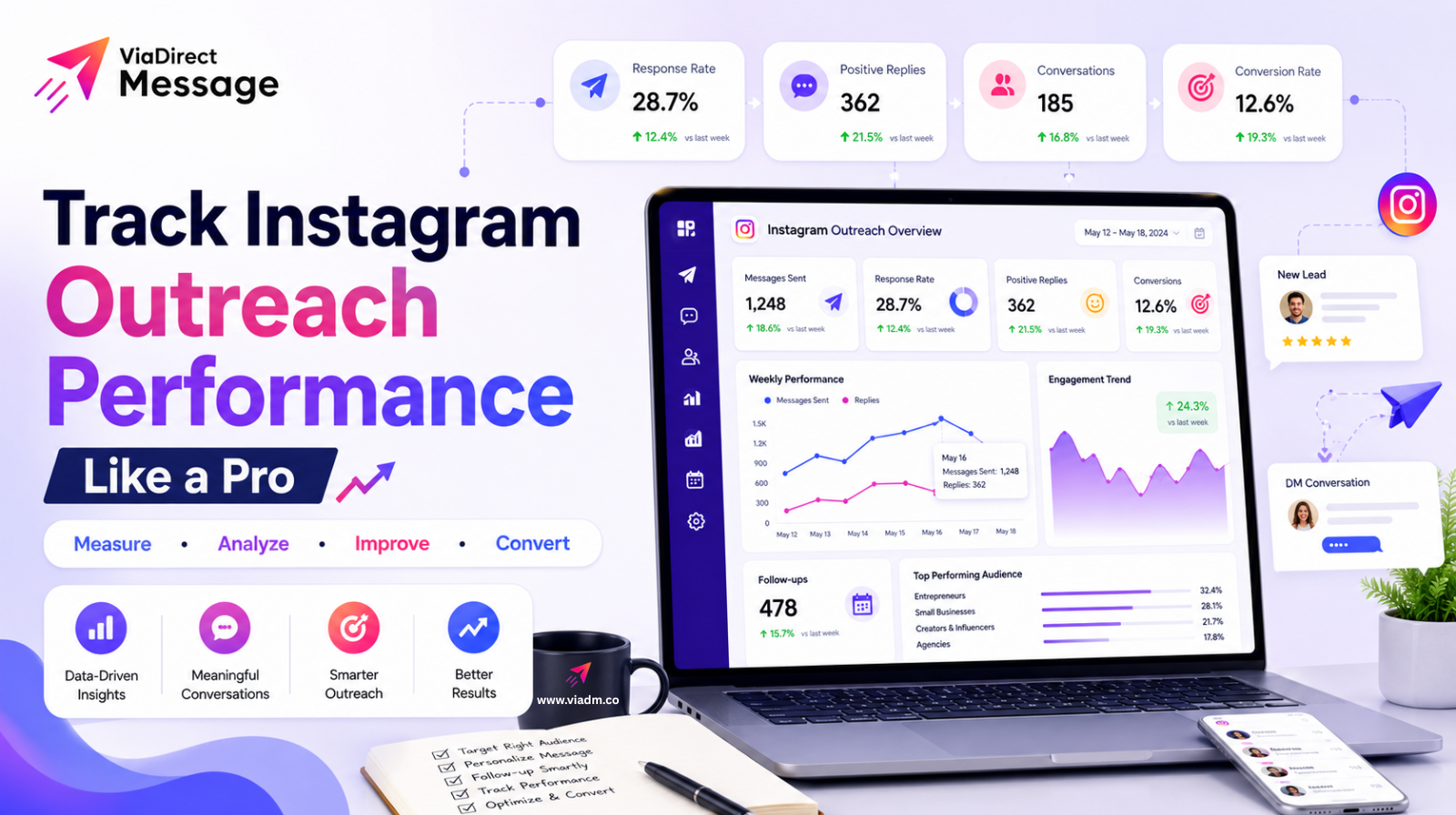
Instagram outreach is no longer just about sending direct messages and hoping for replies. As competition increases and audiences become more selective, successful businesses are shifting their focus from message volume to conversation quality.
Many marketers still judge their campaigns by one simple number—how many people replied. While reply rate is useful, it tells only a small part of the story. A campaign with hundreds of replies may produce very few qualified leads, whereas a smaller outreach campaign with meaningful conversations can generate significantly better business results.
This is why learning how to track Instagram outreach performance has become essential for agencies, consultants, coaches, SaaS companies, ecommerce brands, and service businesses that rely on relationship-based selling.
Rather than measuring success by the number of DMs sent, modern outreach strategies evaluate how conversations progress, how prospects engage, and how many interactions eventually become customers.
For businesses using a manual outreach workflow, organized tracking becomes even more valuable because every conversation represents genuine time, effort, and personalization. Platforms like ViaDM help businesses organize manual Instagram conversations efficiently while keeping every interaction authentic instead of relying on automated messaging.
This guide explores a more practical approach to measuring outreach performance. Instead of focusing only on traditional metrics, you’ll learn how experienced marketers evaluate conversation quality, identify improvement opportunities, and continuously optimize their outreach strategy using meaningful business data.
Why Most Businesses Measure Instagram Outreach Incorrectly
One of the biggest misconceptions in Instagram marketing is believing that sending more messages automatically produces better results.
It rarely works that way.
Imagine two outreach campaigns.
Campaign A
- 600 Messages Sent
- 180 Replies
- 6 Qualified Leads
- 1 New Client
Campaign B
- 250 Messages Sent
- 70 Replies
- 24 Qualified Leads
- 9 New Clients
If you only compare reply rates, Campaign A appears more successful.
However, from a business perspective, Campaign B clearly delivers far greater value.
This example highlights an important lesson:
Instagram outreach performance should be measured by business outcomes—not message volume.
Businesses that consistently generate leads focus less on “How many messages did we send?” and more on questions like:
- Which conversations showed genuine buying intent?
- Which audience segment engaged the most?
- Which message opening created the highest-quality discussions?
- How long did successful conversations take before converting?
- Which follow-up sequence produced meetings?
These questions reveal insights that simple reply counts never can.
What Instagram Outreach Performance Actually Means?
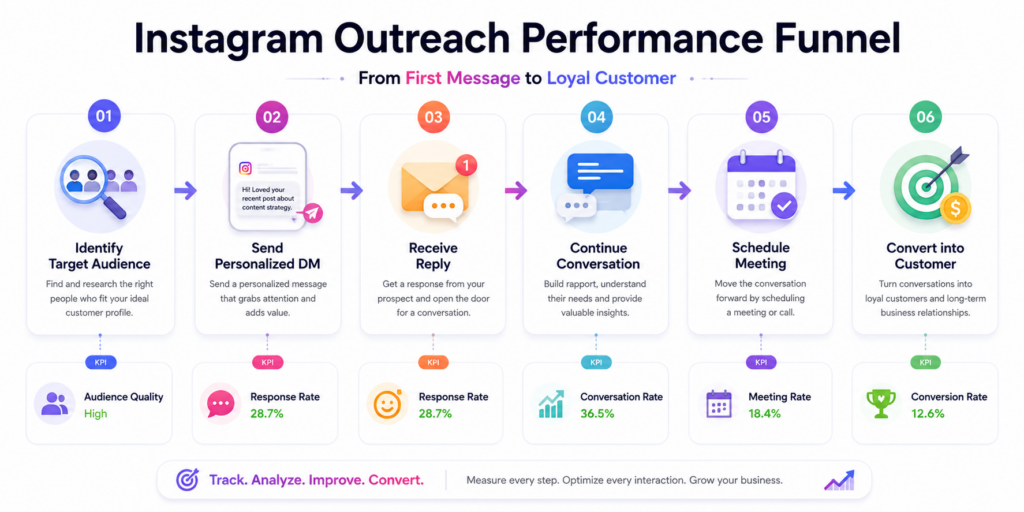
Many articles define outreach performance as measuring replies, clicks, or conversions.
In reality, performance is much broader.
Instagram outreach performance is the process of evaluating how effectively your conversations move prospects from first contact to meaningful business relationships.
Instead of looking at one isolated metric, experienced marketers evaluate the complete customer journey.
A simplified outreach journey looks like this:
Prospect Identified
↓
Personalized First Message
↓
Reply Received
↓
Meaningful Conversation
↓
Qualified Opportunity
↓
Meeting or Product Demo
↓
Customer
↓
Long-Term Relationship
Every stage provides valuable information.
Some businesses generate plenty of replies but struggle to convert conversations into meetings.
Others receive fewer replies but consistently attract highly qualified prospects.
Without tracking every stage, it’s impossible to understand where improvements are needed.
The Outreach Performance Pyramid (A Better Framework)
Most blogs discuss outreach using isolated metrics.
A more practical way is to view outreach as a layered performance system where every stage supports the next.
Layer 1 – Delivery
Questions to evaluate:
- Were messages delivered successfully?
- Were accounts active?
- Did recipients actually receive your outreach?
If delivery is poor, nothing else matters.me.
Layer 2 – Attention
This stage measures whether your message encouraged someone to stop scrolling and read it.
Signals include:
- Profile visits
- Initial replies
- Story interactions after messaging
- Continued profile engagement
A strong first impression determines whether a conversation begins.
Layer 3 – Conversation Quality
Many businesses stop measuring after receiving a reply.
This is a mistake.
Conversation quality answers questions like:
- Did the prospect ask questions?
- Did they continue the discussion?
- Did they share their business challenges?
- Did they request additional information?
Longer, meaningful conversations generally produce better business outcomes than short one-word replies.ality.
Layer 4 – Business Intent
Not every conversation becomes a lead.
At this stage, measure indicators such as:
- Pricing questions
- Product demonstrations requested
- Discovery calls booked
- Consultation requests
- Partnership discussions
These interactions indicate genuine buying interest..
Layer 5 – Revenue Impact
Ultimately, every outreach strategy should contribute to business growth.
This layer measures outcomes like:
- Closed deals
- New customers
- Revenue generated
- Client retention
- Repeat business
- Referrals
When businesses evaluate every layer together, outreach becomes much easier to improve because weaknesses become immediately visible.
The Five Metrics That Actually Predict Outreach Success
Instead of tracking dozens of numbers, focus on a small group of metrics that consistently reveal campaign performance.
1. Conversation Quality Score (CQS)
This metric is rarely discussed, yet it’s often more valuable than response rate.
Rather than asking, “Did someone reply?” ask:
- Was the conversation meaningful?
- Did they ask questions?
- Did they express interest?
- Did they remain engaged?
For example, you can score conversations using a simple framework:
| Conversation Type | Score |
|---|---|
| No Reply | 0 |
| Short Reply | 2 |
| Continued Conversation | 5 |
| Product Discussion | 8 |
| Meeting Scheduled | 10 |
Over time, your average CQS becomes a strong indicator of outreach quality.
2. Reply Intent Ratio
Not every reply has equal value.
Instead of measuring replies collectively, categorize them.
Examples include:
- Interested
- Curious
- Information Seeking
- Referral Opportunity
- Collaboration Inquiry
- Not Interested
This provides a much clearer understanding of how prospects perceive your outreach.
3. Follow-Up Recovery Rate
Many valuable conversations don’t happen after the first message.
Track:
- Number of follow-ups sent
- Replies generated after follow-up
- Meetings booked after second or third message
You may discover that a significant percentage of your best opportunities come from thoughtful follow-ups rather than the initial outreach.
4. Conversation Depth
Conversation depth measures how long meaningful discussions continue.
Instead of counting replies, evaluate:
- Number of back-and-forth messages
- Average conversation duration
- Questions exchanged
- Business topics discussed
Deeper conversations often indicate stronger trust and higher purchase intent.
5. Opportunity Conversion Rate
Rather than tracking every reply, measure how many conversations become real business opportunities.
Examples include:
- Discovery calls
- Product demonstrations
- Proposal requests
- Free trial registrations
- Qualified leads
This metric connects outreach activity directly to business growth instead of vanity numbers.
Segment Your Audience
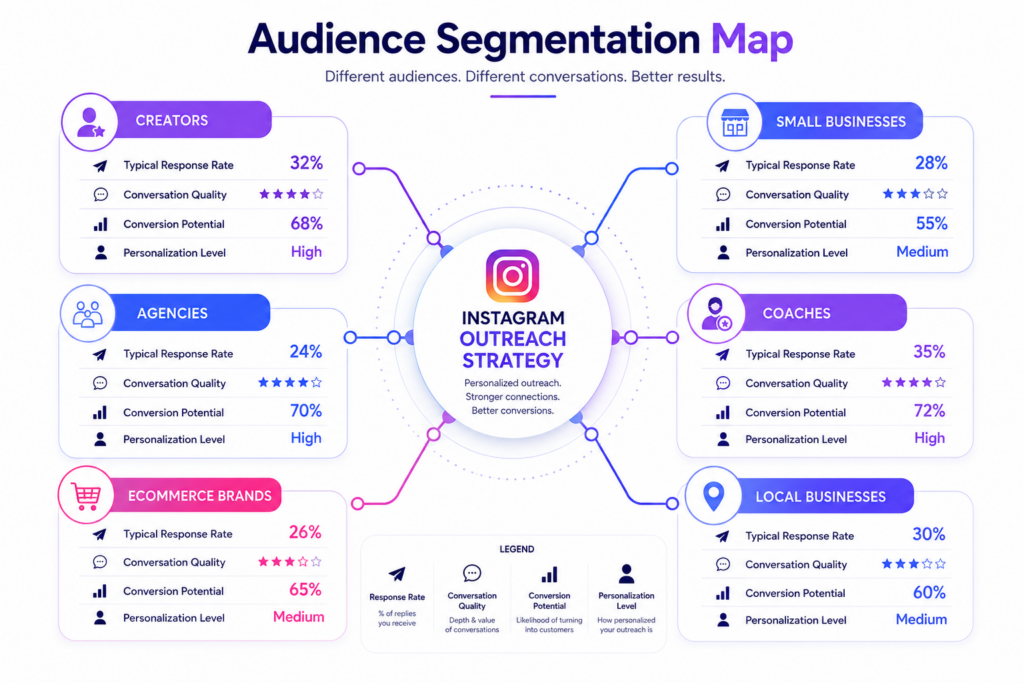
Not every audience behaves the same.
Separate outreach into categories such as:
- Small businesses
- Ecommerce brands
- Agencies
- Influencers
- Coaches
- Local businesses
Compare response rates between groups.
You may discover that creators reply twice as often as ecommerce brands, allowing you to prioritize outreach more effectively.
A Practical Example: Why Quality Beats Volume
Consider two consultants running separate Instagram outreach campaigns over two weeks.
| Metric | Consultant A | Consultant B |
|---|---|---|
| Messages Sent | 500 | 260 |
| Replies | 160 | 82 |
| Qualified Conversations | 18 | 41 |
| Discovery Calls | 5 | 16 |
| New Clients | 2 | 9 |
At first glance, Consultant A appears to perform better because they generated almost twice as many replies.
However, Consultant B focused on highly personalized conversations with a carefully selected audience. Although fewer messages were sent, a much larger percentage turned into genuine business opportunities.
The takeaway is simple: reply volume alone is not a reliable measure of outreach success. Tracking conversation quality and business outcomes provides a much clearer picture of campaign performance.
Build an Outreach Tracking Dashboard That Actually Helps
Many businesses assume they need expensive CRM software to monitor outreach performance.
The reality is much simpler.
A well-structured spreadsheet, CRM, or project management tool can provide nearly everything you need to identify trends and improve future campaigns. The goal isn’t to collect hundreds of data points—it’s to collect the right ones consistently.
A practical dashboard should include information from three areas:
Outreach Activity
Track the effort you’re putting into your campaigns.
Include metrics such as:
- Date
- Campaign Name
- Audience Segment
- Messages Sent
- New Conversations Started
- Follow-ups Sent
This provides a clear picture of daily outreach consistency.
Conversation Quality
Next, evaluate the quality of interactions rather than simply counting replies.
Helpful metrics include:
- Total Replies
- Positive Replies
- Neutral Replies
- Negative Replies
- Average Conversation Length
- Conversation Quality Score (CQS)
Over several weeks, these metrics reveal whether your messaging is attracting the right audience.ks.
Business Results
Finally, connect outreach directly to business growth.
Track outcomes such as:
| Business Metric | Example |
|---|---|
| Discovery Calls Booked | 8 |
| Product Demos | 5 |
| Qualified Leads | 17 |
| Customers Acquired | 4 |
| Revenue Generated | ₹1,80,000 |
When outreach data is connected to business outcomes, decision-making becomes much easier.
Segment Your Audience Before Comparing Results
One mistake many marketers make is combining every conversation into a single report.
Different audiences behave differently.
For example:
| Audience | Typical Behavior |
|---|---|
| Coaches | Respond quickly but require trust |
| Agencies | Ask detailed business questions |
| Ecommerce Brands | Focus on ROI and pricing |
| SaaS Companies | Want product demonstrations |
| Local Businesses | Prefer short conversations |
If one audience consistently produces better results, it deserves more attention and resources.
Audience segmentation helps identify where your outreach generates the highest return.
Measure Conversation Quality Instead of Reply Count
Receiving replies is encouraging, but replies alone rarely indicate campaign success.
Consider these two responses:
Reply A
“Thanks.”
Reply B
“Your message caught my attention. I’d love to know how your process works. Can we schedule a quick call?”
Both count as replies.
Only one creates a business opportunity.
A practical way to evaluate conversations is to classify them into categories:
Informational
The recipient asks basic questions.
Interested
They want additional details about your service.
Opportunity
The conversation moves toward scheduling a meeting or discussing business requirements.
Qualified Lead
The prospect clearly matches your ideal customer profile and shows genuine purchasing intent.
By categorizing conversations this way, you’ll quickly discover which campaigns generate meaningful engagement rather than superficial responses.
Evaluate Message Performance Like an Experiment
Many businesses change multiple things at once:
- New audience
- New message
- Different timing
- Different offer
When results improve, they don’t know which change caused it.
Instead, treat outreach like a controlled experiment.
For one week, modify only your opening sentence.
Everything else should remain consistent.
For example:
Version A
Hi Sarah, I came across your recent content on Instagram and thought I’d reach out.
Version B
Hi Sarah, I noticed how consistently you’re helping ecommerce founders grow their brands. I have an idea that might interest you.
Track:
- Reply Rate
- Conversation Quality
- Discovery Calls
- Qualified Leads
Small improvements in message quality often produce significant long-term gains.
Review Performance Every Week
Daily monitoring is useful for maintaining consistency.
Weekly reviews reveal trends.
During your weekly review, ask questions like:
- Which audience responded the most?
- Which message opening performed best?
- Which conversations generated meetings?
- Which follow-up sequence worked?
- Which campaign should be paused?
- Which campaign deserves more investment?
Rather than reacting to one day’s results, evaluate performance over a longer period to make more informed decisions.
Common Mistakes That Reduce Outreach Performance
Mistake 1: Prioritizing Volume Over Quality
Sending hundreds of generic messages may increase activity but often reduces conversation quality.
Well-researched, personalized outreach consistently performs better over time.
Mistake 2: Ending the Conversation Too Early
Many businesses stop after receiving one reply.
In reality, valuable conversations usually develop through thoughtful follow-ups.
Relationship building requires patience.
Mistake 3: Ignoring Follow-Up Timing
Following up too soon may appear pushy.
Waiting too long can cause prospects to lose interest.
Tracking response patterns helps determine the most effective timing for your audience.
Mistake 4: Measuring Every Campaign Together
A campaign targeting startup founders should never be compared directly with one targeting local restaurants.
Each audience has unique behavior, expectations, and response patterns.
Analyze them separately.
Mistake 5: Chasing Vanity Metrics
Large reply counts may look impressive in reports but don’t necessarily generate business.
Instead, prioritize metrics that contribute directly to growth:
- Revenue
- Qualified Conversations
- Meetings
- Product Demonstrations
- Sales Opportunities
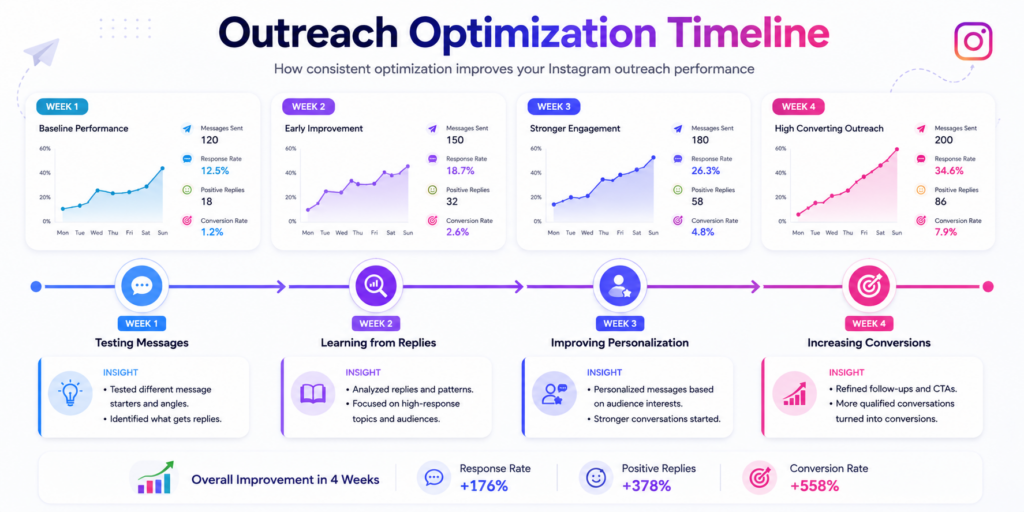
A Realistic Campaign Optimization Example
Imagine a digital marketing agency runs a manual Instagram outreach campaign for four weeks.
Week 1
- Messages Sent: 300
- Replies: 82
- Qualified Conversations: 18
- Discovery Calls: 4
After reviewing performance, they identify three opportunities:
- Personalized openings receive significantly more replies.
- Marketing agencies engage more than ecommerce brands.
- Morning outreach generates stronger conversation quality.
Instead of increasing message volume, they adjust only these areas.
Week 4
- Messages Sent: 300
- Replies: 106
- Qualified Conversations: 39
- Discovery Calls: 15
The number of messages remained the same.
The improvement came from better targeting, stronger personalization, and continuous performance analysis.
This demonstrates why successful outreach depends on optimization rather than simply sending more messages.
Tools That Help Organize Outreach Performance
You don’t necessarily need enterprise software to build an effective tracking system.
Many businesses successfully manage outreach using tools such as:
- Google Sheets
- Microsoft Excel
- Airtable
- Notion
- HubSpot CRM
- Zoho CRM
- ClickUp
- Trello
If your strategy involves manual Instagram messaging, using an organized workflow tool can help keep conversations structured while preserving authentic human interactions. Unlike automation platforms, ViaDM is designed to support manual Instagram outreach, making it easier to manage conversations without replacing genuine communication.
For broader guidance on measuring digital marketing performance, resources from Google Analytics and the Content Marketing Institute offer valuable frameworks that complement Instagram outreach analysis.
How Often Should You Review Outreach Performance?
Different metrics require different review schedules.
Daily
- Messages sent
- Replies
- Follow-ups
Weekly
- Response rate
- Positive conversations
- Message performance
Monthly
- Lead generation
- Revenue
- Conversion trends
- Overall campaign improvements
Consistent reviews make optimization much easier.
Future Trends in Instagram Outreach Performance
As Instagram continues to evolve, businesses are placing greater emphasis on relationship quality rather than outreach volume.
Several trends are expected to shape future outreach strategies:
- Deeper CRM integration with social conversations
- Improved lead qualification workflows
- AI-assisted analytics for reporting (while keeping outreach human-led)
- Conversation sentiment analysis
- Better attribution between Instagram conversations and sales outcomes
- Stronger personalization through first-party customer insights
Although analytics tools will become more sophisticated, one principle is unlikely to change:
People respond to genuine, relevant conversations—not mass messaging.
Businesses that combine thoughtful communication with structured performance tracking will be better positioned to build lasting customer relationships.
✔ Final Performance Checklist
Before launching your next outreach campaign, review this checklist:
- Define a clear business objective.
- Identify your target audience.
- Personalize every first message.
- Track conversation quality—not just reply count.
- Categorize replies by intent.
- Measure follow-up effectiveness.
- Review performance every week.
- Compare audience segments separately.
- Focus on qualified opportunities instead of vanity metrics.
- Continuously refine your outreach based on real data.
Frequently Asked Questions (FAQs)
How do I know if my Instagram outreach campaign is successful?
Success shouldn’t be measured solely by the number of replies. A successful campaign generates meaningful conversations that lead to qualified opportunities, meetings, partnerships, or customers. Tracking conversation quality alongside business outcomes provides a much more accurate picture of performance.
Which metric is the most important?
There isn’t a single metric that applies to every business. However, Conversation Quality Score, Qualified Conversations, Discovery Calls, and Opportunity Conversion Rate generally provide more meaningful insights than reply rate alone.
How often should outreach data be reviewed?
Daily reviews help maintain consistency, weekly reviews identify trends, and monthly reviews measure overall business impact. Using all three review cycles creates a balanced performance management process.
Can small businesses track outreach without expensive software?
Yes. A structured spreadsheet or a simple CRM is often sufficient for monitoring outreach activity, conversation quality, and business outcomes. The consistency of your tracking process matters more than the tool you choose.
Does personalization really improve outreach performance?
In most cases, yes. Personalized messages are more likely to start meaningful conversations because they demonstrate genuine interest in the recipient. Over time, this often leads to stronger engagement and higher-quality business opportunities compared with generic outreach.
Conclusion
Learning how to track Instagram outreach performance is about much more than counting messages or celebrating high reply rates. The most successful businesses evaluate the complete journey—from the first personalized message to the final business outcome.
By focusing on conversation quality, reply intent, audience segmentation, follow-up effectiveness, and opportunity conversion, you gain insights that help refine your outreach strategy over time. Small improvements in targeting, messaging, and performance analysis can compound into stronger relationships, more qualified leads, and sustainable business growth.
If your team relies on manual Instagram outreach, organizing conversations and monitoring meaningful performance metrics becomes even more important. Solutions like ViaDM can support this process by helping businesses manage personalized outreach workflows efficiently while keeping every interaction authentic and relationship-focused.
The businesses that consistently succeed on Instagram aren’t necessarily the ones sending the most messages—they’re the ones learning from every conversation and using those insights to build smarter, more effective outreach strategies.