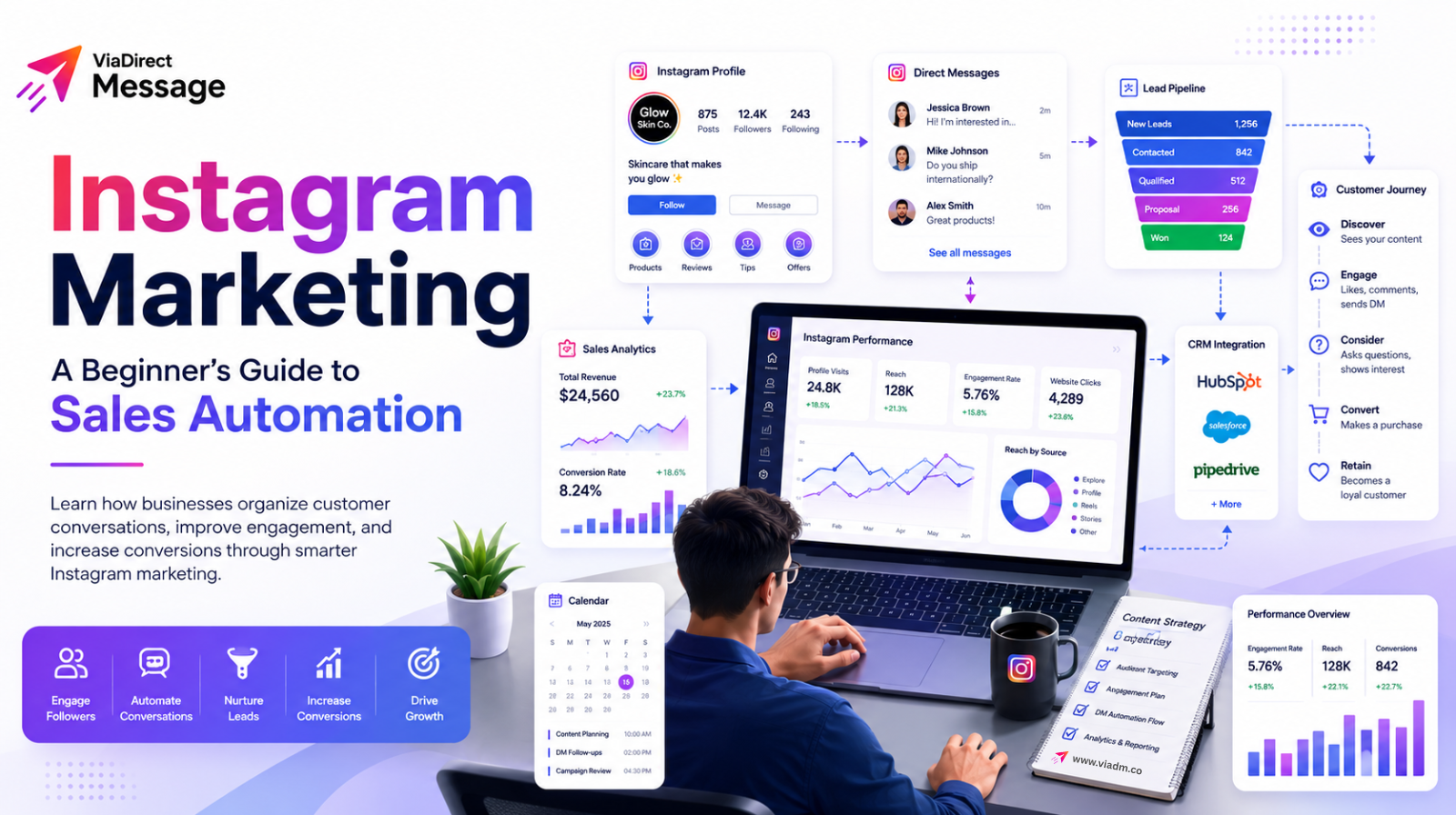
Instagram has evolved into a powerful channel where people research products, evaluate businesses, ask questions, and make buying decisions. For businesses, this means Instagram marketing is no longer limited to publishing attractive posts. The platform can also support product discovery, lead generation, customer conversations, and long-term relationship building.
As those interactions increase, however, managing them becomes more complicated. A growing business may need to keep track of interested prospects, unanswered inquiries, follow-ups, customer questions, and campaign performance at the same time. This is where Instagram marketing sales automation becomes useful—but automation does not have to mean automatically sending direct messages.
A more practical approach is to streamline repetitive work around the sales process. Lead organization, follow-up reminders, campaign tracking, CRM updates, and performance reporting can become more structured, while conversations that require context and judgment remain human-led. This balance helps businesses improve efficiency without turning Instagram outreach into impersonal mass messaging.
For teams that prefer to keep direct conversations under human control, a solution such as ViaDM’s manual Instagram outreach platform can support a more organized outreach workflow. ViaDM is a manual outreach platform rather than an Instagram DM automation tool, so the person using it remains responsible for selecting prospects and managing conversations.
Throughout this beginner’s guide, we will look at where automation genuinely adds value, which Instagram sales activities are better handled manually, how to build a simple prospect-to-customer workflow, and which metrics can reveal whether your strategy is producing meaningful business results. Instead of treating higher message volume as the goal, the focus will be on creating relevant conversations, improving follow-up consistency, and building an Instagram marketing sales automation process that can grow alongside your business.
What Is Instagram Marketing Sales Automation?
Instagram marketing sales automation is the use of technology and structured workflows to reduce repetitive work across the Instagram sales process. The goal is not simply to increase the number of activities a business can perform. Instead, it is to give marketers more time to focus on relevant prospects, useful conversations, and measurable business outcomes.
For example, a business can streamline tasks such as:
- Organizing and qualifying prospects
- Recording lead information
- Setting follow-up reminders
- Tracking sales opportunities
- Categorizing prospects by interest or buying stage
- Monitoring campaign performance
- Updating CRM records
- Reviewing conversion data
However, there is an important distinction between sales workflow automation and automated Instagram messaging. A business can automate administrative and reporting tasks while keeping direct conversations manual.
This distinction is especially important for relationship-based Instagram marketing. A prospect may have a specific question, business situation, or reason for showing interest. A human can understand that context and adjust the conversation accordingly, while a generic automated message may not.
For example, instead of automatically sending the same promotional message to every prospect, a sales representative can review a prospect’s profile, identify a relevant reason for reaching out, and start a personalized conversation. The surrounding workflow can then help the representative organize the lead and remember appropriate follow-ups.
In other words, effective Instagram marketing sales automation should support the salesperson rather than attempt to replace the salesperson.
A practical model is:
Technology handles repetitive workflow → People handle meaningful conversations → Analytics measures the outcome.
This approach also makes it easier to build an Instagram sales process that can grow without sacrificing relevance or personalization.
Why Instagram Has Become a Powerful Sales Channel
Instagram has developed far beyond a platform for publishing photos and short-form videos. For many consumers, it is now part of the product discovery and research process. People can discover a business through content, visit its profile, review its products or services, and start a conversation before they ever visit the company’s website.
For businesses, this creates an opportunity to connect with potential customers at several stages of the buying journey.
Instagram can support activities such as:
- Building brand awareness
- Demonstrating products and services
- Sharing educational content
- Identifying potential prospects
- Answering customer questions
- Starting one-to-one conversations
- Directing interested users to relevant website pages
- Supporting lead-generation campaigns
- Maintaining relationships with existing customers
The scale of social media also makes Instagram commercially significant. DataReportal’s Digital 2026 Global Overview Report provides current research on worldwide digital and social media usage, giving businesses useful context when evaluating the size and importance of social platforms.
However, reach alone does not create sales.
The real opportunity comes from combining visibility with relevance. Someone who discovers a product through an Instagram post may still need additional information before becoming a customer. A useful conversation can help answer questions, clarify the offer, and determine whether the product or service is actually suitable.
This is where Instagram differs from a purely one-way advertising channel.
A potential customer might:
- Discover a brand through Instagram content.
- Visit the business profile.
- Interact with a post or Story.
- Send a Direct Message with a question.
- Receive a relevant response.
- Visit the website or product page.
- Become a qualified lead or customer.
A well-designed Instagram marketing sales automation workflow can help businesses organize these stages without making the interaction itself feel automated.
Instagram Is Not Just About Message Volume
One common mistake is assuming that more Instagram messages automatically produce more sales.
Consider two hypothetical campaigns.
- Campaign A contacts 500 poorly targeted accounts with the same generic sales message.
- Campaign B identifies 80 relevant prospects and starts personalized conversations based on their business, interests, or recent activity.
Campaign A may generate a much larger activity number. Campaign B may generate fewer conversations but potentially more qualified opportunities.
The exact outcome will vary by industry, offer, audience, and execution, so there is no universal conversion rate that should be treated as a guaranteed benchmark.
The more useful question is:
Are your Instagram activities creating meaningful business opportunities?
That means measuring more than messages sent. Track replies, meaningful conversations, qualified leads, meetings, sales opportunities, and revenue where possible.
When Instagram marketing is evaluated this way, sales automation becomes a process-improvement tool rather than simply a method for increasing outreach volume.
Understanding the Instagram Sales Journey
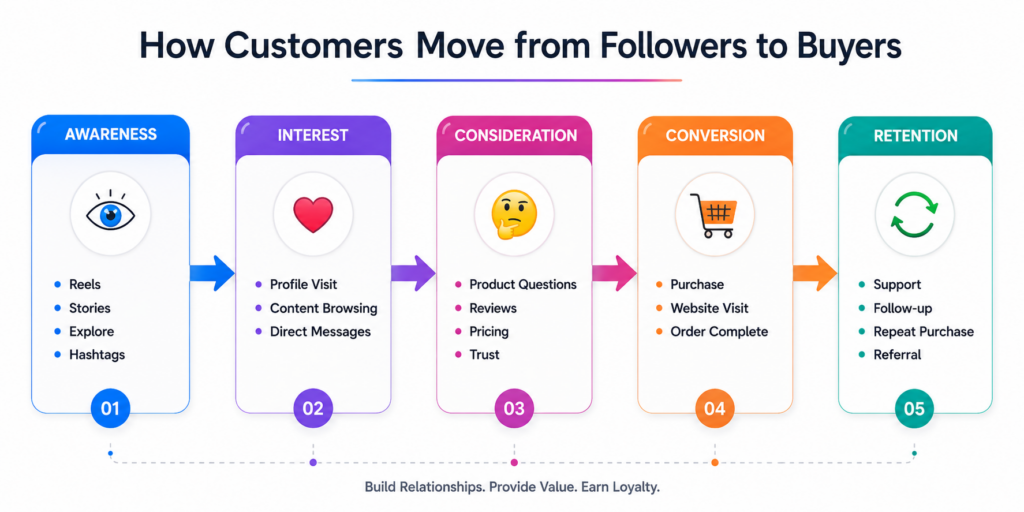
Successful Instagram marketing is rarely about convincing someone to purchase after a single interaction. In most cases, people need time to discover a business, understand its offer, evaluate whether it is trustworthy, and decide whether it is relevant to their needs.
The Instagram sales journey can therefore be viewed as a sequence of stages:
Awareness → Interest → Consideration → Conversion → Retention
Each stage requires a slightly different approach. The role of Instagram marketing sales automation is to help organize the process around these stages, while keeping important customer interactions relevant and human-led.
Awareness: Getting Discovered
Every customer journey begins with discovery.
A potential customer may encounter a business through:
- Instagram Reels
- Stories
- Explore recommendations
- Relevant hashtags
- Creator or influencer collaborations
- Paid campaigns
- Shares and recommendations
- Educational or industry-specific content
At this stage, the primary objective is not to make an immediate sale. It is to earn attention from people who may genuinely benefit from what the business offers.
For example, a software company might publish a short educational Reel explaining a common workflow problem. Someone searching for a solution may discover the content, visit the company’s profile, and begin exploring its services.
This creates the first connection.
The quality of content matters because sales conversations become easier when prospects already understand who you are and what problem you solve.
Interest: Turning Attention Into Engagement
After discovering a business, interested users often investigate further.
They may:
- Visit the Instagram profile
- Read the bio
- Watch Story Highlights
- Browse previous posts
- Visit the website
- Save or share content
- Comment on a post
- Send a Direct Message
This stage is important because the prospect is moving from passive discovery toward active interest.
A prompt and useful response can make a strong first impression. However, fast does not necessarily mean automated. The best response depends on what the person actually asked and the context of the conversation.
For businesses using Instagram marketing sales automation, this is an opportunity to organize incoming leads, record relevant information, and create follow-up reminders while keeping the actual conversation under human control.
Consideration: Helping Prospects Make a Decision
During consideration, potential customers usually evaluate whether a business is the right choice.
They may ask:
- Is this company trustworthy?
- Does the product solve my specific problem?
- How is it different from alternatives?
- What do existing customers say?
- Is the pricing appropriate?
- What happens after I purchase?
- How responsive is the business?
At this point, aggressive selling can work against you.
Instead, provide information that helps the prospect make a confident decision. That could include educational content, product details, relevant examples, FAQs, demonstrations, or a clear explanation of how the service works.
For businesses improving their Instagram DM strategy, resources such as the ViaDM Blog’s Instagram outreach and messaging guides can provide additional ideas for creating more relevant and personalized conversations without treating manual outreach as automated messaging.
The objective is simple: make the buying decision easier, not more pressured.
Conversion: Turning Intent Into Action
Once a prospect understands the offer and feels comfortable with the business, they may be ready to take the next step.
Depending on the business model, conversion could mean:
- Purchasing a product
- Booking a consultation
- Requesting a demonstration
- Starting a free trial
- Submitting a lead form
- Requesting a quotation
- Signing up for a service
A smooth conversion experience removes unnecessary friction.
Businesses should make important information easy to find, including:
- Pricing or pricing guidance where appropriate
- Product or service details
- Purchase instructions
- Contact options
- Relevant policies
- Delivery or onboarding information
- Clear next steps
For example, if someone has already asked about a service through Instagram, sending them to a complicated website with no obvious next step can interrupt the buying journey.
The better approach is to connect the conversation with a clear and relevant action.
Retention: What Happens After the Sale?
The Instagram sales journey does not end when someone becomes a customer.
Retention is an important part of long-term growth because existing customers already understand the brand and may have future needs.
Businesses can strengthen customer relationships through:
- Helpful educational content
- Product updates
- Customer support
- Relevant announcements
- Loyalty or exclusive offers
- Personalized follow-ups
- Useful post-purchase information
For example, a customer who purchases a professional service may later need an upgrade, additional service, training, or support. A useful relationship after the original purchase can create opportunities that would not exist if communication stopped immediately after the transaction.
This is also where organized sales workflows become valuable. A business can use its CRM, customer records, analytics, and follow-up processes to maintain consistency without turning every interaction into an automated message.
The Complete Instagram Sales Journey
When these stages work together, the journey looks like this:
Discover → Explore → Engage → Ask → Evaluate → Decide → Purchase → Return
The objective of Instagram marketing sales automation should be to make this journey easier to manage, not to force every prospect through the exact same path.
Different customers will move at different speeds. Some may purchase quickly, while others may need several conversations before making a decision.
The most effective Instagram strategy recognizes that difference and combines structured technology with human judgment at every stage where context matters.
Manual Outreach vs. Sales Automation
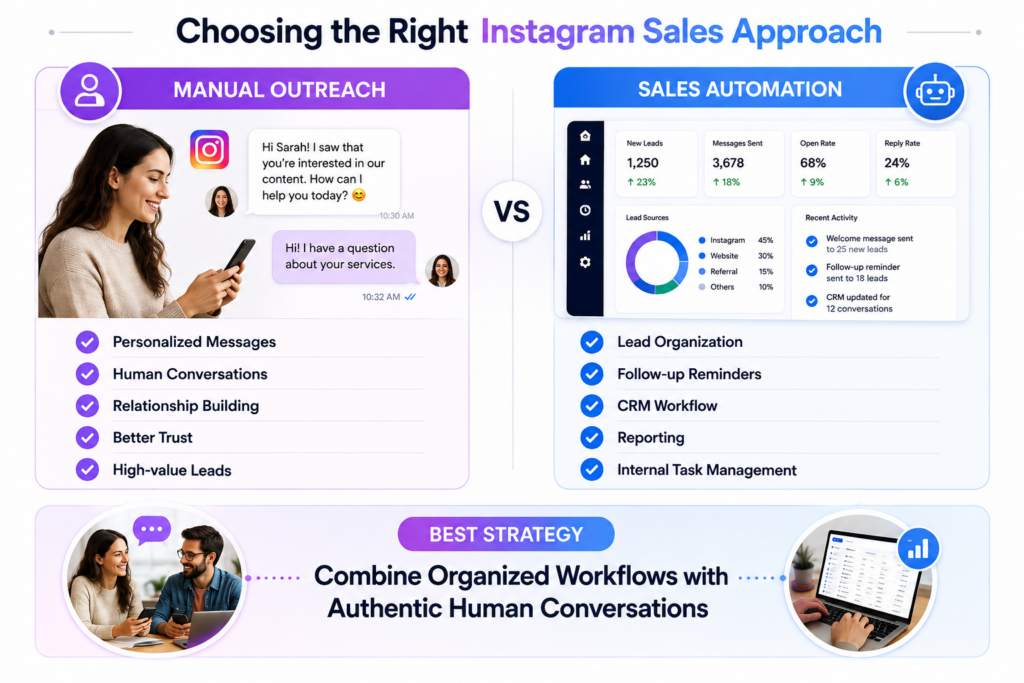
One of the most common misunderstandings about Instagram marketing sales automation is the assumption that every part of the customer conversation should be automated.
That approach can create unnecessary problems. Instagram is a social platform, and many sales opportunities depend on context, trust, timing, and genuine communication.
A better approach is to identify which activities benefit from technology and which require human judgment.
For example, a business may use technology to organize prospects, track lead stages, record campaign performance, or create follow-up reminders while keeping the actual Instagram conversation manual.
This creates a useful distinction:
Manual outreach = human-controlled communication
Sales workflow automation = streamlined repetitive processes
Automated messaging = technology sending messages without the same level of individual human control
These are not the same thing.
When Manual Outreach Performs Better
Personalized communication becomes particularly valuable when the product or service requires trust, explanation, or consultation before purchase.
Manual outreach can be especially useful for:
- B2B businesses
- Marketing agencies
- Coaches and consultants
- SaaS businesses
- Professional service providers
- High-value products and services
- Businesses with longer sales cycles
- Relationship-driven sales
Consider a consultant contacting a business owner after noticing a specific problem with the company’s Instagram presence.
A generic message such as:
“Hi, we provide marketing services. Would you like to know more?”
provides little context.
A human-reviewed message could instead mention a genuine observation and ask a relevant question. That gives the prospect a reason to respond and creates an opportunity for an actual conversation.
This is one reason some businesses prefer manual outreach platforms over automation-heavy messaging systems. ViaDM is not an automation tool. It is a manual Instagram DM platform designed to help users manage and organize outreach while keeping the actual message selection and sending under human control.
The distinction matters because the value of manual outreach is not simply that a person presses the Send button. The real advantage is that the person can decide who to contact, why to contact them, what to say, and how to respond based on the conversation.
Where Sales Workflow Automation Can Be Helpful
Automation still has a legitimate role in an Instagram sales process.
The key is using it where repetitive administrative work can be reduced without replacing meaningful communication.
Examples include:
- Organizing lead information
- Updating CRM records
- Creating follow-up reminders
- Categorizing prospects
- Recording sales stages
- Preparing campaign reports
- Tracking website conversions
- Creating internal workflow notifications
- Reviewing performance data
For example, after a salesperson has a meaningful conversation with a prospect, the team can record the prospect’s status in a CRM and schedule an internal follow-up reminder. The reminder supports the sales process without automatically sending another Instagram message.
That is a more controlled use of technology.
Businesses should also review Instagram’s current Community Guidelines and platform guidance before designing technology-assisted workflows. Platform rules and features can change, so relying on old advice about Instagram activity can create unnecessary risks.
For the website side of the strategy, marketers should also follow current Google Search Central guidance when publishing supporting content, implementing structured SEO practices, or evaluating search visibility.
Benefits of Instagram Marketing Sales Automation
When used appropriately, Instagram marketing sales automation can improve the organization around a sales process without removing the human element from customer communication.
The biggest benefits are usually related to efficiency, consistency, visibility, and scalability.
Saves Valuable Time
Sales teams often spend significant time on administrative work that does not directly create customer value.
A structured workflow can reduce time spent on tasks such as:
- Updating lead records
- Searching for old conversations
- Remembering follow-ups
- Preparing reports
- Sorting prospects
- Checking campaign performance
The time saved can then be invested in higher-value activities such as:
- Creating better content
- Researching prospects
- Having meaningful customer conversations
- Improving products or services
- Handling sales objections
- Developing marketing strategies
The objective is not to eliminate human involvement. It is to use human time where it matters most.
Creates Consistent Workflows
As a business grows, informal processes become harder to manage.
A salesperson may remember to follow up with one prospect but forget another. Another team member may categorize leads differently. A third person may keep important information in a separate spreadsheet.
A structured workflow creates consistency.
Teams can establish clear stages such as:
New Prospect → Contacted → Replied → Qualified → Follow-Up → Opportunity → Customer
This makes it easier to understand where each lead stands and what action should happen next.
Consistency also improves the customer experience because fewer inquiries are forgotten or handled inconsistently.
Improves Lead Management
Managing a small number of conversations is relatively simple. Managing hundreds of potential prospects requires a system.
A structured process can address common problems:
| Common Challenge | Structured Approach |
|---|---|
| Lost prospect information | Centralized lead records |
| Missed follow-ups | Follow-up reminders |
| Unqualified prospects | Lead categorization |
| Unclear ownership | Assigned sales stages |
| Limited visibility | Campaign reporting |
| Difficult performance analysis | Consistent metrics |
The goal is not to turn every Instagram conversation into a data point.
Instead, relevant information should be captured so sales teams can make better decisions.
For example, if a prospect has already explained that they are not currently looking for a solution, repeatedly treating them as a new lead creates unnecessary noise. A structured system can record that context and help the team prioritize more relevant opportunities.
Supports Business Growth
Growth can expose weaknesses that are not obvious when a business is small.
A founder might personally remember every prospect when there are 20 conversations. That same approach becomes difficult when several team members manage hundreds of leads.
Without a repeatable process, businesses may experience:
- Missed qualified opportunities
- Inconsistent follow-ups
- Duplicate outreach
- Poor lead visibility
- Slow response to important inquiries
- Inconsistent customer experiences
A well-organized workflow provides a foundation for scaling.
However, scaling should not mean automatically increasing message volume. A better goal is to increase the number of relevant opportunities that a team can manage effectively.
For businesses that prioritize personalized communication, a manual outreach process supported by structured lead management can provide a practical balance between productivity and personalization.
Common Instagram Marketing Mistakes Beginners Make
Many businesses assume that increasing Instagram activity automatically leads to more sales.
It does not.
A successful strategy depends on targeting, relevance, communication quality, follow-up, and measurement.
Here are several mistakes that can weaken an Instagram sales process.
Sending Generic Messages
Copy-and-paste messages are easy to recognize.
A message that could be sent to hundreds of businesses without changing a single sentence usually gives the recipient little reason to engage.
Instead, personalization should be based on genuine context.
For example, a sales representative might notice that a prospect recently published content about expanding into a new market. That observation can provide a natural reason to start a conversation.
The message should still be concise and respectful. Personalization does not mean writing a long paragraph about everything you discovered about the prospect.
A useful rule is:
Relevant observation + clear reason for contacting + easy-to-answer question.
Focusing Only on Selling
Instagram is not simply a digital product catalogue.
People use the platform to learn, discover ideas, follow creators, research businesses, and interact with communities. If every interaction immediately turns into a sales pitch, potential customers may lose interest.
Instead, create a balanced content strategy that can include:
- Educational posts
- Industry insights
- Tutorials
- Product demonstrations
- Customer stories
- Behind-the-scenes content
- Frequently asked questions
- Practical tips
This approach gives potential customers useful reasons to interact with your brand before they are asked to buy.
For example, a software company could publish a practical tutorial that solves a common problem. Someone who finds the tutorial useful may later visit the company’s profile, ask a question, or explore the product.
That creates a more natural path from content → interest → conversation → consideration → conversion.
Treating Message Volume as the Main KPI
Sending more messages is not necessarily a sign of better performance.
A campaign should also consider:
- Response quality
- Qualified leads
- Meaningful conversations
- Meetings booked
- Opportunities created
- Customers acquired
- Revenue generated
This prevents teams from optimizing for activity while overlooking business results.
Ignoring the Context of the Conversation
A prospect who asks a specific question should not receive an unrelated promotional response.
Likewise, someone who has already explained their requirements should not be treated like a completely new lead during the next interaction.
Keeping conversation context is one of the strongest arguments for maintaining human involvement in Instagram outreach.
Building the Strategy Around Automation Instead of Customers
Technology should solve a business problem.
Before introducing another automation or sales tool, ask:
What repetitive problem are we actually trying to solve?
- If the problem is missed follow-ups, improve follow-up organization.
- If the problem is poor targeting, improve prospect research.
- If the problem is unclear reporting, improve measurement.
- If the problem is weak conversations, improve messaging and sales training.
- Automation alone cannot fix an unclear marketing strategy.
The strongest Instagram marketing sales automation systems start with a clear customer journey and then use technology selectively to make that journey easier to manage.
Best Practices for Instagram Marketing Sales Automation
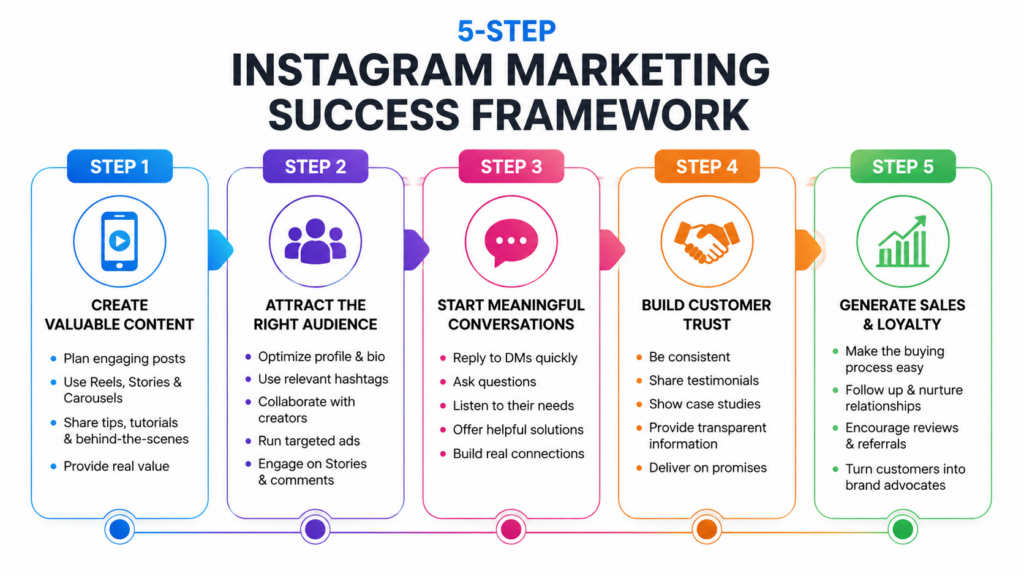
A strong Instagram marketing strategy is not built around automation alone. It depends on relevance, consistency, useful content, timely responses, and a clear understanding of the customer journey.
For businesses using Instagram marketing sales automation, the most effective approach is usually to streamline repetitive sales and marketing workflows while keeping important customer conversations human-led.
Before changing your process, define what you actually want to improve. A clear objective makes it easier to choose the right tools, measure results, and identify whether a change is genuinely helping the business.
Start With Clear Marketing Goals
Different businesses use Instagram for different reasons.
Your primary objective might be:
- Generating qualified leads
- Increasing website visits
- Booking consultations
- Selling products
- Increasing qualified DM conversations
- Improving response times
- Supporting existing customers
- Building long-term brand awareness
Avoid choosing a goal simply because it is easy to measure.
For example, increasing the number of messages sent may look like progress, but it does not necessarily mean your sales process is improving. A better objective could be increasing the number of qualified conversations generated from a specific audience.
Once the goal is defined, select supporting metrics that show whether you are moving toward it.
Understand the Customer Before Building the Workflow
A sales workflow should follow the customer journey rather than force every customer into the same process.
Consider what happens before a prospect sends a DM:
Content discovery → Profile visit → Interest → Conversation → Qualification → Purchase
Some people may move through these stages quickly. Others may need more information before they are ready to talk to a salesperson.
Understanding this journey helps you decide where technology can reduce repetitive work and where human judgment is necessary.
For example, organizing lead information can be streamlined, but deciding how to respond when a prospect explains a specific business problem is better handled by a person who understands the context.
Segment Your Audience
Not every Instagram follower has the same needs or buying intent.
Depending on your business, useful segments could include:
- New followers
- Content engagers
- Potential prospects
- Returning customers
- Existing clients
- Previous inquiries
- Business partners
Segmentation allows you to provide more relevant communication.
For example, someone who has already purchased your product should not necessarily receive the same introductory information as someone discovering your brand for the first time.
A simple segmentation system can also make your reporting more useful because you can compare how different groups behave instead of treating your entire audience as one large number.
Keep Important Conversations Personal
A structured workflow should never become an excuse for sending identical messages to everyone.
Personalization can be based on genuine context, such as:
- A question the prospect previously asked
- A relevant product or service
- A recent interaction with your content
- Their business type
- A problem they mentioned
- Their position in the buying journey
For example, a business consultant could refer to a specific business challenge mentioned by a prospect rather than sending a generic introduction.
The goal is not to make every message extremely long. Good personalization can be simple:
Relevant context + useful reason for contacting + natural question.
This is particularly important for B2B services, consulting, agencies, professional services, and other offers where trust plays an important role in the buying decision.
Respond Promptly Without Sacrificing Relevance
Response time can influence the customer experience, particularly when someone is actively asking about pricing, availability, product details, or a service.
However, speed should not come at the expense of quality.
Imagine two businesses receive similar product inquiries. One responds quickly with a relevant answer and clear next steps. The other takes much longer and responds with a generic message that does not address the customer’s question.
The first business has a natural advantage because it demonstrates both responsiveness and understanding.
Instead of focusing only on responding as quickly as possible, establish a practical internal process for identifying priority inquiries and making sure important conversations are not forgotten.
Track Performance Beyond Message Volume
Successful Instagram marketing requires measurement.
Useful metrics can include:
- Qualified prospects contacted
- DM response rate
- Meaningful conversation rate
- Follow-up completion rate
- Website visits from Instagram
- Qualified leads
- Consultation bookings
- Sales opportunities
- Customer conversions
- Revenue attributed to campaigns
For example:
Lead Conversion Rate = Customers ÷ Qualified Leads × 100
If 50 qualified leads produce 5 customers, the conversion rate for that stage is 10%.
The number alone does not tell you why the result occurred. That is why it should be reviewed alongside audience quality, offer, messaging, sales process, and campaign context.
For website and search performance, businesses can also use Google Search Console’s performance and search reporting resources to understand how their website appears in Google Search. Search Console is not an Instagram analytics platform, but it can complement an Instagram strategy when Instagram content is used to drive people toward website resources, landing pages, or product content.
Build Evidence From Your Own Campaigns
One of the best ways to improve an Instagram marketing strategy is to document what actually happens in your campaigns.
Instead of presenting generic industry statistics as proof, maintain your own records.
Useful evidence can include:
- Campaign dates
- Target audience
- Number of qualified prospects
- Number of conversations started
- Reply rates
- Qualified leads
- Meetings booked
- Sales generated
- Website traffic
- Screenshots of dashboards
- Anonymized conversation examples
When publishing a case study, clearly distinguish between observed results from your own campaign and general industry observations.
This makes the content more trustworthy and prevents a hypothetical example from being presented as a verified business result.
Illustrative Campaign Example: From Content to Qualified Conversations
Consider a hypothetical skincare business introducing a new facial serum.
Instead of immediately contacting every follower with a promotional message, the business first publishes educational content about skincare routines, ingredient selection, and common skin concerns.
Some users interact with the content and later send questions about the product.
The team then handles those conversations manually. One person may ask about ingredients, another may want to know whether the product suits a particular routine, while another may simply want to understand the price.
The team records relevant lead information and follows up where appropriate.
The business can then compare metrics before and after introducing this structured process.
For example, it might create an internal report like this:
| Metric | Previous Process | New Process |
|---|---|---|
| Average response time | 12 hours | 2 hours |
| Qualified inquiries | 85 | 162 |
| Website visits from Instagram | 240 | 390 |
| Purchases attributed to tracked campaigns | 19 | 41 |
Important: These figures are an illustrative example, not claimed industry benchmarks or independently verified campaign results. A real case study should replace them with documented results from an actual campaign and explain the measurement period, audience, campaign conditions, and attribution method.
This distinction is important when publishing marketing content. Real campaign evidence is more valuable than impressive numbers without supporting methodology.
Choosing the Right Instagram Marketing Workflow
There is no single workflow that is ideal for every business.
The right approach depends on your sales cycle, audience, product complexity, team size, and the amount of personalization required.
| Business Type | Suitable Approach |
| Local service business | Personalized conversations + lead tracking |
| Marketing agency | Manual outreach + organized CRM workflow |
| High-ticket coaching | Human-led conversations + structured follow-up |
| E-commerce business | Content + organized inquiries + customer support |
| B2B company | Research-driven outreach + qualification |
| Professional services | Personalized outreach + consultation workflow |
These are starting points, not universal rules.
A business selling a simple consumer product may require a different process from a company selling a high-value B2B service.
For businesses that want to organize manual Instagram outreach while keeping conversations under human control, ViaDM’s pricing and feature information can be reviewed as one option for managing manual Instagram messaging.
ViaDM should not be positioned as an automated messaging solution. Its role is to support manual Instagram outreach and personalized direct conversations.
Instagram Marketing Myths You Should Ignore
Myth 1: More Messages Automatically Mean More Sales
Message volume is an activity metric, not a revenue metric.
Sending more messages can increase activity while producing fewer qualified opportunities if the audience or message quality is poor.
A better strategy is to focus on:
Relevant prospects → meaningful conversations → qualified opportunities → customers
Myth 2: Automation Replaces Human Relationships
Technology can organize information and reduce repetitive work, but it does not automatically understand every customer situation.
A prospect may ask an unexpected question, raise an objection, or explain a problem that requires a contextual response.
That is where human judgment remains valuable.
Myth 3: Every Business Needs Full Automation
Different businesses have different sales processes.
A consultant, agency, professional service provider, or B2B company may rely heavily on trust and discussion. In these cases, replacing conversations with generic automated interactions may not improve the customer experience.
Instead, automate or streamline the administrative work around the conversation.
Myth 4: Instagram Sales Depend Only on Direct Messages
Direct Messages are only one part of Instagram marketing.
A complete strategy can include:
- Reels
- Carousel posts
- Stories
- Educational content
- Product demonstrations
- Customer testimonials
- Community engagement
- Profile optimization
- Website content
These elements work together.
A prospect may discover your Reel today, visit your profile tomorrow, read your website next week, and eventually start a conversation.
That is why Instagram should be viewed as part of a broader customer journey rather than an isolated DM channel.
Pricing Comparison: Manual Outreach vs. Heavy Automation
Price should not be the only factor when evaluating an Instagram sales workflow.
Consider the total value of the process.
| Factor | Manual Outreach | Heavy Automation |
| Message personalization | High | Depends on implementation |
| Human review | Yes | May be limited |
| Relationship building | Strong | Depends on workflow |
| Administrative efficiency | Requires organization | Often higher |
| Conversation control | High | Depends on implementation |
| Best fit | Relationship-driven sales | Repetitive, rules-based workflows |
| Main consideration | Time and consistency | Relevance, control, and platform requirements |
This comparison is intentionally general because tools differ significantly in their features and implementation.
Businesses should also verify current product capabilities, pricing, and Instagram requirements before making a purchasing decision.
For relationship-driven Instagram marketing, a useful model is often:
Manual conversations + organized workflow + measurable reporting
rather than assuming that maximum automation is automatically the best solution.
Frequently Asked Questions
Is Instagram marketing sales automation suitable for beginners?
Yes, but beginners should start with the basics.
First define the target audience, customer journey, offer, and sales goal. Then identify repetitive tasks that genuinely need to be streamlined.
Do not introduce automation simply because another business is using it.
Does manual Instagram outreach still work?
Manual outreach can be effective when the audience is relevant and the communication provides a genuine reason to start a conversation.
It is particularly useful when the product or service requires trust, explanation, or consultation.
Results vary significantly by industry, targeting, offer, messaging, and execution, so businesses should measure their own campaigns rather than rely on a universal success rate.
Can sales workflow automation improve customer experience?
Yes, when it reduces problems such as missed inquiries, forgotten follow-ups, poor lead organization, or inconsistent internal processes.
However, workflow automation should not be confused with automatically replacing customer conversations.
The customer should still receive a relevant response to their actual question.
How quickly should businesses respond to Instagram DMs?
Businesses should aim to respond within a reasonable timeframe based on their resources and customer expectations.
For high-intent inquiries, faster responses can be especially valuable.
However, a thoughtful response that actually answers the customer’s question is more useful than an immediate generic reply.
What should beginners focus on first?
Start with five fundamentals:
- Define your ideal customer
- Publish useful and relevant content
- Create a clear Instagram profile
- Respond consistently to genuine inquiries
- Measure qualified outcomes
Once these foundations are working, you can identify which repetitive tasks should be streamlined.
How can I know whether my Instagram strategy is working?
Look beyond follower growth.
Review whether Instagram is contributing to:
- Qualified conversations
- Website visits
- Leads
- Booked consultations
- Sales opportunities
- Purchases
- Repeat customers
Where possible, connect Instagram activity with website analytics and your sales records so you can evaluate the complete customer journey.
Conclusion
Instagram Marketing: A Beginner’s Guide to Sales Automation is ultimately about finding the right balance between operational efficiency and authentic communication.
Technology can make repetitive work easier. It can help organize prospects, track follow-ups, structure sales pipelines, and measure campaign performance. However, those benefits do not mean every Instagram interaction should be automated.
The stronger approach is to use technology where it genuinely improves the workflow while keeping conversations personal when context and trust matter.
Start with the fundamentals:
Define the right audience. Create useful content. Start relevant conversations. Follow up consistently. Measure qualified outcomes. Improve based on evidence.
Businesses should also avoid unsupported performance claims. When publishing case studies, screenshots, campaign results, or statistics, use documented information and clearly label hypothetical examples. This creates more credible content and gives readers information they can actually evaluate.
For businesses that prefer human-controlled Instagram outreach, a manual platform such as ViaDM’s Instagram outreach solution can fit into this broader strategy by helping organize personalized Instagram conversations without positioning the platform as an automated DM tool.
Ultimately, successful Instagram marketing sales automation is not about removing people from the sales process. It is about removing unnecessary friction from the process so people can spend more time doing what technology cannot easily replace: understanding customers, answering questions, building trust, and having meaningful conversations.