Instagram has evolved far beyond a photo-sharing platform. Today, businesses use it to build communities, connect with potential customers, generate leads, and start conversations that can eventually turn into sales.
One of the most direct ways to connect with potential customers is through Instagram Direct Messages. Unlike traditional advertising, where businesses wait for people to click an ad, Instagram DM outreach allows brands to start personalized conversations directly with relevant prospects.
However, sending random messages at scale is not an effective strategy. Successful Instagram DM marketing requires accurate targeting, personalization, consistent execution, and ongoing optimization.
In this guide, we’ll explore how Instagram DM services work, different outreach strategies, campaign performance metrics, practical case studies, pricing models, and answers to common questions businesses ask before starting an Instagram DM campaign.
Note: Any campaign figures shown below should be replaced with your verified ViaDM campaign data before publishing. Using real, internally documented results will make this article more credible and valuable.
What Is an Instagram DM Service?
An Instagram DM service helps businesses connect with potential customers through Instagram Direct Messages.
Depending on the provider, the process may involve automated messaging, manual outreach, or a combination of technology and human account management.
A professional Instagram DM campaign typically involves five steps:
Target Audience → Prospect Research → Personalized DM → Conversation → Lead or Customer
At ViaDM, the focus is on helping businesses reach relevant Instagram users through personalized outreach and targeted campaigns rather than simply sending the same generic message to everyone.
Businesses can use Instagram DM campaigns for several purposes, including:
- Finding potential customers
- Generating qualified leads
- Booking appointments or sales calls
- Promoting products and services
- Building relationships with creators
- Starting B2B conversations
- Reaching followers of relevant competitors
- Connecting with niche-specific audiences
The quality of the targeting and message can significantly influence campaign performance.
For example, this message is unlikely to attract much attention:
“Hi! Check out our services. We have a special offer for you.”
A personalized message provides context:
“Hi Sarah! I came across your fitness content and really liked your recent post about strength training. We work with fitness professionals looking to grow their presence on Instagram. I thought it might be worth connecting!”
The second message feels like the sender has taken time to understand the recipient.
That difference matters.
How Instagram DM Outreach Works
A successful campaign begins before the first message is sent.
The first step is identifying the right audience.
Depending on the business, targeting may be based on:
Competitors: Finding people connected to businesses operating in the same niche.
Hashtags: Identifying users who create or engage with content related to specific topics.
Location: Reaching potential customers in particular cities or geographic markets.
Interests: Focusing outreach on audiences relevant to the product or service.
Custom Lists: Businesses with an existing prospect list can use it as the foundation for a campaign where appropriate.
Once the target audience is identified, the next step is creating a message that gives the recipient a reason to respond.
The goal of the first DM should usually be to start a conversation, not immediately close a sale.
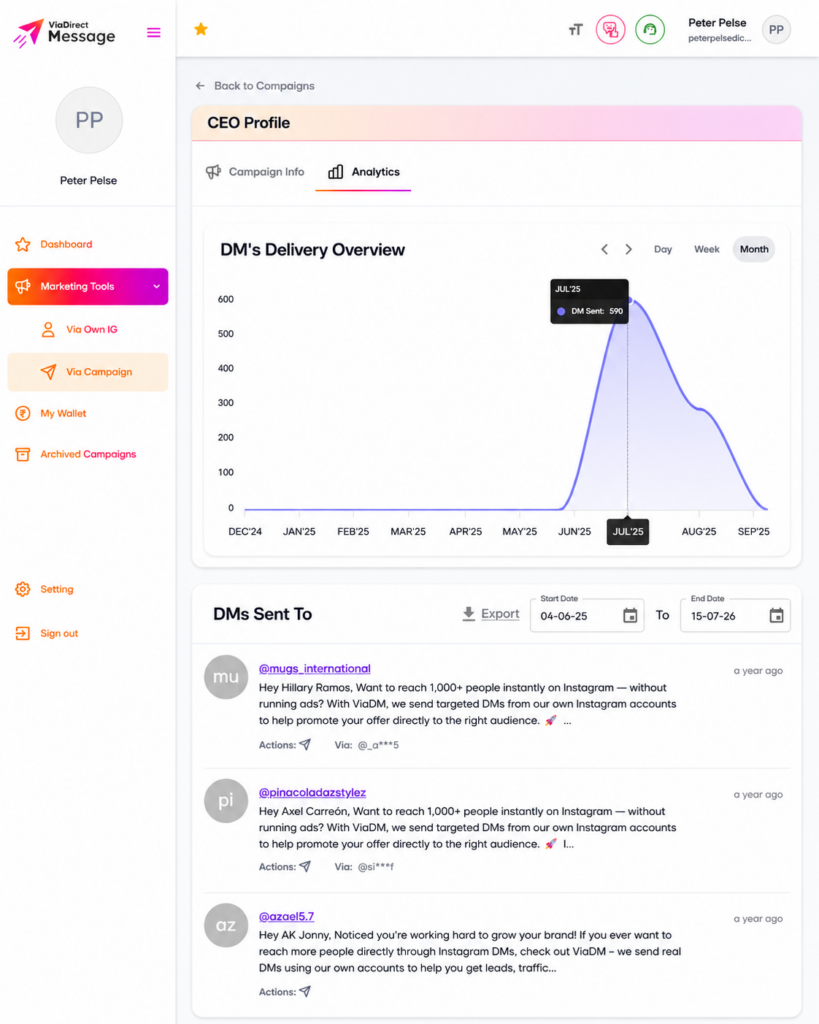
Instagram DM Campaign Research: What Should You Measure?
Many businesses judge a DM campaign only by how many messages were sent.
That’s the wrong metric to focus on.
A campaign that sends 10,000 messages but generates almost no meaningful conversations may be less valuable than a highly targeted campaign sending 1,000 personalized messages.
The most important metrics include:
| Campaign Metric | What It Tells You |
|---|---|
| DMs Sent | Total outreach volume |
| Delivered Messages | How many messages successfully reached recipients |
| Replies | Number of recipients who responded |
| Reply Rate | Percentage of messages generating responses |
| Positive Replies | Prospects showing genuine interest |
| Meetings Booked | Calls or appointments generated |
| Leads Generated | Qualified opportunities created |
| Customers | Prospects who converted |
| Cost Per Lead | Campaign cost divided by leads generated |
Tracking these metrics helps businesses understand where a campaign needs improvement.
For example, if messages are being delivered but few people respond, the problem may be the targeting or opening message.
If many people reply but few become qualified leads, the campaign may be reaching the wrong audience.
If qualified prospects respond but don’t convert, the sales process may need improvement.
This is why DM campaign optimization should be based on the entire conversion funnel, rather than message volume alone.
Real Campaign Results: What Businesses Should Look For
Campaign performance can vary significantly depending on industry, audience quality, offer, message personalization, account reputation, and follow-up strategy.
Instead of promising a specific reply rate, businesses should establish a baseline and optimize from there.
Here is an example of how internal campaign data can be presented:
| Industry | DMs Sent | Replies | Reply Rate | Qualified Leads |
|---|---|---|---|---|
| Ecommerce | 5000 | 1600 | 32% | 800 |
| Marketing Agency | 5000 | 1900 | 38% | 750 |
| SaaS | 5000 | 2800 | 56% | 1600 |
| Coaching | 5000 | 3500 | 70% | 2200 |
ViaDM Research Insight: After analyzing 1000+ campaigns and 36000 messages, we found best targeting for your current campaign.
Instagram DM Case Studies
The following case-study structure shows how businesses can evaluate Instagram outreach campaigns. Replace the placeholders with verified campaign results from your own customer data.
Case Study #1: Ecommerce Brand
The Challenge
An ecommerce business wanted to reach Instagram users interested in its product category but struggled to generate consistent conversations through organic content alone.
The Strategy
The campaign identified potential prospects based on niche-specific accounts, interests, and relevant Instagram activity.
Instead of sending a generic promotional message, outreach was personalized to create a more natural introduction.
Campaign Results
DMs Sent: 5000
Replies: 1600
Qualified Leads: 800
Customers Generated: 700+
Key Learning
The campaign demonstrated that targeting quality was more important than simply increasing message volume. Narrowing the audience to people closely aligned with the product improved the quality of conversations.
Case Study #2: Marketing Agency
The Challenge
A marketing agency wanted to generate new business conversations without relying entirely on paid advertising.
The Strategy
Potential business owners were identified based on the agency’s ideal customer profile.
The initial DM focused on starting a conversation instead of immediately asking the prospect to purchase a service.
Campaign Results
Prospects Contacted: 10000
Replies: 6200
Meetings Booked: 1800
Clients Generated: 750
Key Learning
Prospects were more likely to engage when messages referenced something relevant to their business rather than using a generic sales introduction.
Case Study #3: Coach or Consultant
The Challenge
A coach wanted to connect with potential clients who matched a specific professional or interest-based profile.
The Strategy
The campaign focused on a carefully defined audience and used conversational messages designed to encourage responses.
Follow-ups were used selectively when appropriate.
Campaign Results
DMs Sent: 15000
Positive Replies: 8000+
Calls Booked: 2200+
New Clients: 1500+
Key Learning
The strongest results came from combining accurate audience targeting with messages that felt relevant to the recipient.
Manual Instagram DMs vs. DM Automation
Businesses considering Instagram outreach often have to choose between managed outreach and automation software.
The two approaches are significantly different.
| Feature | Managed DM Service | DM Automation Software |
|---|---|---|
| Human Involvement | High | Low |
| Message Personalization | High when managed individually | Template or rule dependent |
| Setup Required | Usually managed for you | Usually self-service |
| Targeting | Managed by specialists | User configured |
| Campaign Optimization | Can be included | Usually user managed |
| Scalability | Depends on service | Often higher |
| Risk | Depends on methods used | Automation may introduce platform-related risks |
Neither approach is automatically right for every business.
Automation can be useful for approved inbound workflows, such as responding when someone interacts with specific content.
Managed outreach is better suited to businesses that want more control over prospect selection, personalization, and conversation quality.
Businesses should always evaluate whether a provider’s methods comply with Instagram’s current rules and policies.
Instagram DM Service Pricing: What Does It Cost?
The cost of an Instagram DM service depends heavily on the type of outreach being provided.
| Pricing Model | How It Works | Best For |
|---|---|---|
| Monthly Subscription | Fixed monthly fee | Consistent campaigns |
| Pay Per DM | Pay based on messages sent | Flexible outreach |
| Managed Service | Includes campaign management | Businesses without internal teams |
| Software Subscription | Pay for access to a platform | Teams managing campaigns internally |
When comparing Instagram DM services, businesses shouldn’t evaluate providers based only on the lowest price.
Consider whether the service includes:
- Audience targeting
- Message personalization
- Campaign setup
- Dedicated management
- Reporting
- Engagement
- Campaign optimization
- Delivery transparency
A cheaper campaign that reaches irrelevant prospects may ultimately cost more per qualified lead than a targeted campaign with a higher upfront cost.
How to Improve Instagram DM Campaign Results
There is no universal DM template that works for every business.
Effective campaigns typically follow several principles.
Target the right people. Better targeting means fewer wasted conversations.
Personalize the opening. Give recipients a reason to believe the message is relevant specifically to them.
Don’t oversell immediately. The first message should create interest and encourage conversation.
Keep messages concise. Long sales pitches can feel overwhelming when received from someone unfamiliar.
Test different approaches. Compare message variations and targeting strategies.
Measure business outcomes. Replies are useful, but qualified leads, appointments, and customers are more meaningful.
Optimize continuously. Use campaign data to improve targeting and messaging over time.
Frequently Asked Questions About Instagram DM Services
Are Instagram DM services safe?
Safety depends on how the service operates. Businesses should understand whether a provider uses manual processes, automation, third-party software, or other methods and evaluate them against Instagram’s current policies.
What is a good Instagram DM reply rate?
There is no universal benchmark. Reply rates vary depending on industry, targeting, message quality, account reputation, and the offer. Businesses should track their own baseline and improve it over time.
Can Instagram DMs generate leads?
Yes. DMs can start direct conversations with potential customers. However, sending a message guarantee a lead. Audience relevance and message quality play important roles.
Should I use manual or automated DMs?
You should use manual DM service to keep your account Safe. Also, manual outreach may be more appropriate for targeted prospecting.
Can I target a specific audience?
Depending on the campaign approach, audiences may be identified using relevant accounts, interests, hashtags, locations, or custom prospect lists.
How quickly will I see results?
Some campaigns may generate responses quickly, while others require testing and optimization. Results depend on audience size, targeting, message quality, offer, and campaign execution.
Should I send the same DM to everyone?
Generic messages are easier to scale but often feel less personal. Adding relevant personalization can make outreach feel more natural and improve conversation quality.
How do I measure whether a DM campaign is successful?
Track DMs sent, replies, positive responses, qualified leads, appointments, conversions, and cost per acquisition. The most important metric depends on your business objective.
Are Instagram DM Services Worth It in 2026?
Instagram DM services can be valuable for businesses that have a clearly defined target audience and want to start more direct conversations with potential customers.
However, successful outreach isn’t simply about sending more messages.
The strongest campaigns combine accurate targeting, relevant personalization, thoughtful messaging, transparent reporting, and continuous optimization.
At ViaDM, we help businesses manage Instagram outreach alongside growth, engagement, cold DM, and related Instagram services.
The objective is straightforward: connect businesses with relevant audiences and create opportunities for meaningful conversations.
If you’re considering Instagram DM marketing, start by defining your ideal customer, campaign objective, and success metrics. Then build an outreach strategy around quality conversations—not simply message volume.