
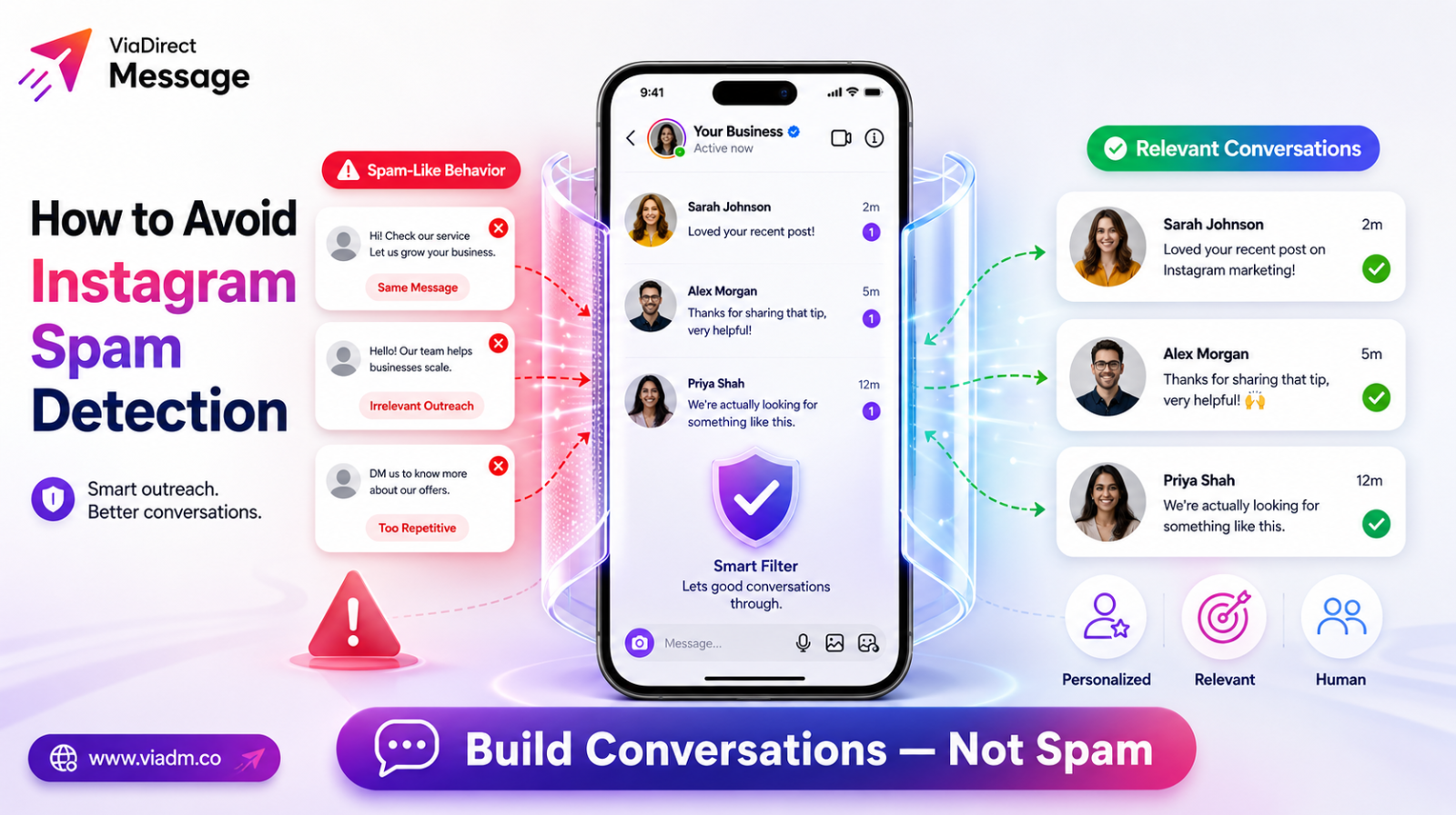
Instagram can be an effective channel for building relationships, generating leads, and starting conversations with potential customers. However, businesses that send too many repetitive or poorly targeted messages can run into spam-related restrictions.
Understanding how to avoid Instagram spam detection is therefore important for anyone using Instagram for business outreach.
The key is not simply to send fewer messages. Instead, businesses need to create genuine conversations, personalize their outreach, respect Instagram’s rules, and avoid behavior that looks like spam.
For beginners, it also helps to understand the difference between structured Instagram marketing and aggressive automated activity. A useful introduction to the broader subject is this guide to Instagram Marketing for Beginners and Sales Automation, which explains how businesses can approach Instagram conversations as part of a wider sales strategy.
This guide explores the practical signals that can make Instagram activity appear spammy, the mistakes businesses should avoid, and a safer approach to manual Instagram outreach.
What Is Instagram Spam Detection?
Instagram spam detection refers to the systems Instagram uses to identify behavior that may violate its Community Guidelines, Terms of Use, or other platform policies.
These systems can evaluate many different signals rather than relying on one simple rule.
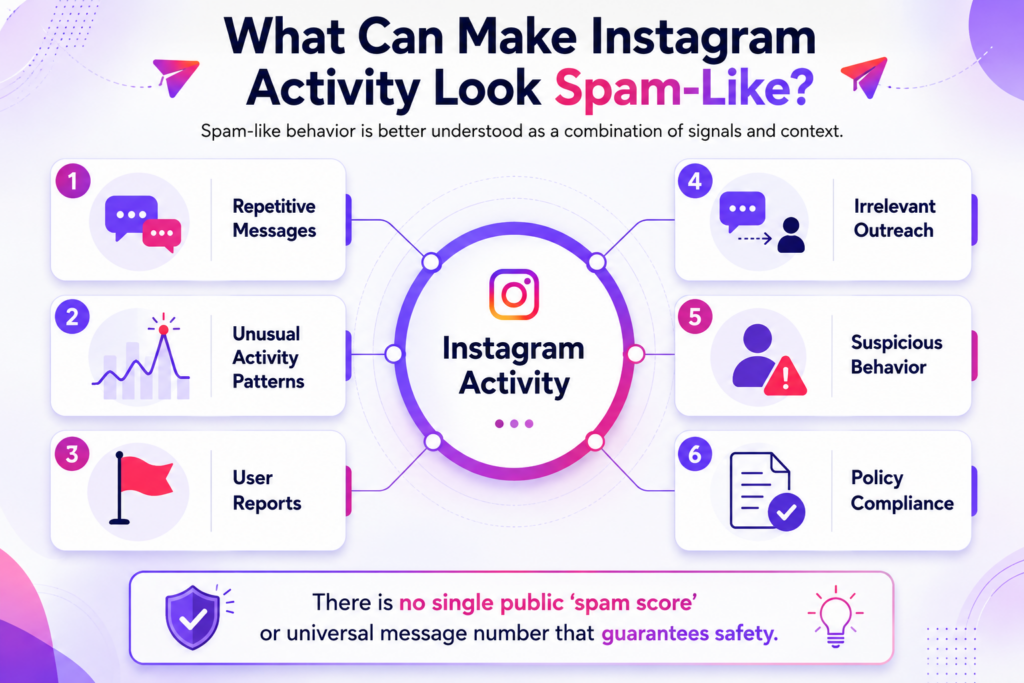
For example, Instagram may consider patterns involving:
- Repetitive messages
- Unusual increases in activity
- Large numbers of similar interactions
- Content or accounts receiving spam reports
- Suspicious account behavior
- Repeated actions that appear inauthentic
- Attempts to manipulate engagement
- Activity that conflicts with Instagram’s policies
Instagram does not publish a universal formula such as “send X messages and you will be blocked.” That distinction is important.
A business should therefore avoid trying to find a magic number of messages that can supposedly be sent safely. Instead, focus on creating behavior that looks natural, relevant, and useful to the person receiving the message.
Instagram’s own Community Guidelines provide the broader policy framework for acceptable behavior across Meta’s platforms.
Why Does Instagram Detect Spam-Like Activity?
Spam creates a poor experience for users.
Imagine someone follows a business account and immediately receives the same promotional message several times. Even if the business has a legitimate product, the recipient may consider the interaction unwanted.
At scale, this type of behavior can damage both the user experience and the reputation of the account.
Instagram therefore has an incentive to identify patterns associated with unwanted or deceptive behavior.
The important point for marketers is that spam detection is about behavior and context, not simply message volume.
A small account sending highly repetitive messages can potentially look more suspicious than a larger account having genuine conversations with relevant people.
How to Avoid Instagram Spam Detection
The most effective way to avoid Instagram spam detection is to make your outreach resemble real communication.
That means researching the recipient, writing relevant messages, varying your wording naturally, and allowing conversations to develop instead of treating every interaction as a sales opportunity.
Here are the most important practices.
1. Personalize Your Instagram Messages
Personalization is one of the simplest ways to make outreach more relevant.
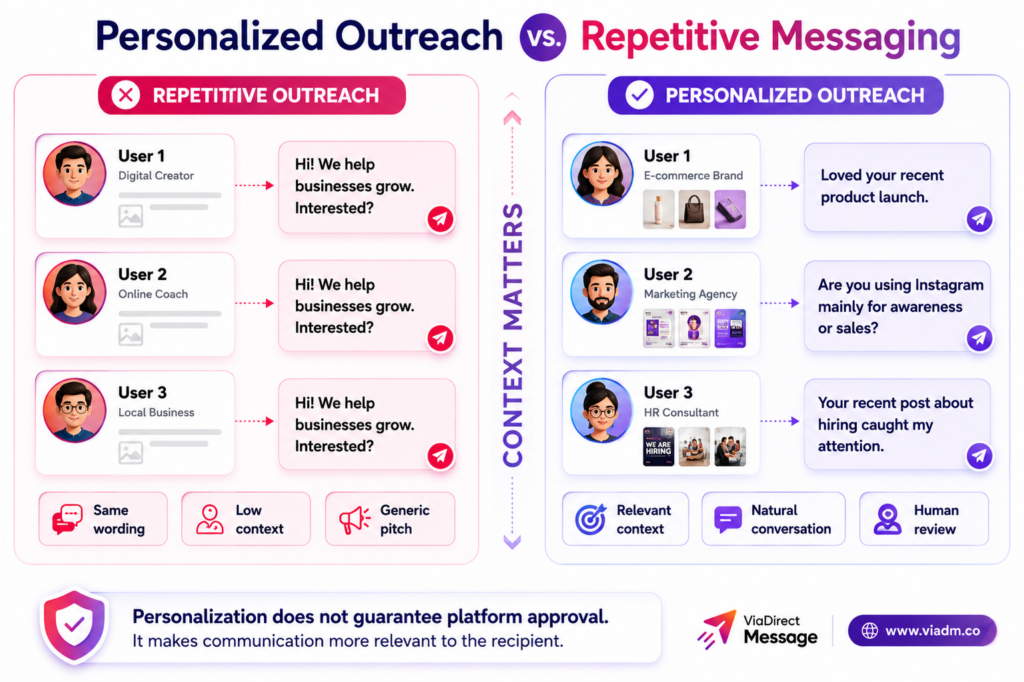
A generic message such as:
“Hi! We provide the best marketing services. Would you like to know more?”
can easily feel like mass outreach.
A better message demonstrates that the sender actually looked at the person’s profile or business.
For example:
“Hi Sarah, I noticed your recent post about expanding your local fitness studio. The way you’re using short-form content to highlight member results is interesting. Are you currently handling your lead follow-up through Instagram?”
The second message gives the recipient a reason to respond.
Personalization does not mean writing an entirely different sales script for every person. It means adding relevant context so the message feels connected to the recipient.
What Can You Personalize?
Consider using information such as:
- Their name
- Their business type
- A recent post
- A product or service they offer
- A relevant professional interest
- A genuine reason for contacting them
Avoid inserting random personal details simply to make a message appear personalized. The information should have a legitimate connection to the conversation.
2. Avoid Sending the Same Message Repeatedly
Repetition is one of the biggest problems in Instagram outreach.
Suppose a business sends essentially the same message to hundreds of accounts:
“Hi! We help businesses grow. Interested?”
Even when the recipients are legitimate prospects, the pattern is highly repetitive.
Instead, develop several conversation frameworks.
For example:
Opening:
“Hi Alex, came across your page while looking at independent design studios. Your recent branding project caught my attention.”
Conversation starter:
“Are most of your new clients coming through referrals or social media at the moment?”
Value-based follow-up:
“Thanks for sharing. I noticed one thing on your profile that could potentially make your enquiry process easier.”
These are conversation structures rather than one message copied everywhere.
The goal should not be to disguise mass messaging. The goal should be to communicate with people individually and meaningfully.
3. Don’t Send Messages to Completely Irrelevant People
Targeting matters as much as wording.
If a company sells accounting software for small businesses, randomly contacting teenagers, unrelated entertainment accounts, or completely unrelated industries makes little sense.
Poor targeting can lead to:
- Low response rates
- More ignored messages
- More negative feedback
- More reports
- Poor account reputation
- Wasted sales time
A smaller list of highly relevant prospects is often more valuable than a huge list of random accounts.
For businesses building a manual Instagram outreach workflow, the Instagram outreach platform approach can help keep prospect research and personalized conversations focused rather than treating every account as an identical target.
4. Avoid Sudden Changes in Activity
Another important principle is consistency.
An account that normally has limited activity and suddenly begins performing a large number of repetitive actions can create an unusual activity pattern.
This does not mean that every increase in activity is automatically spam.
A legitimate campaign, product launch, or active marketing period can naturally increase engagement.
However, sudden behavior changes combined with repetitive actions can be more concerning.
A better approach is to build outreach into your normal marketing workflow.
For example:
- Research prospects regularly
- Start relevant conversations
- Respond to existing conversations
- Follow up where appropriate
- Publish useful content
- Engage naturally with relevant posts
This creates a more balanced presence.
5. Focus on Conversations Instead of Message Counts
One of the worst ways to manage Instagram outreach is to measure success only by the number of messages sent.
Imagine two marketers.
Marketer A
- Sends 300 generic messages
- Gets 8 replies
- Has 1 meaningful conversation
Marketer B
- Starts 60 highly relevant conversations
- Gets 18 replies
- Has 12 meaningful conversations
- Generates several qualified opportunities
The second approach can be much more valuable despite using fewer messages.
A practical dashboard should therefore track metrics such as:
| Metric | What It Shows |
|---|---|
| Qualified prospects | Quality of targeting |
| Messages started | Outreach activity |
| Response rate | Relevance of opening |
| Meaningful conversations | Conversation quality |
| Qualified leads | Sales potential |
| Meetings/bookings | Commercial intent |
| Negative responses | Targeting or messaging problems |
This approach also helps businesses identify problems before they become platform problems.
6. Don’t Use Misleading or Manipulative Messages
Spam is not only about frequency.
The content itself matters.
Avoid messages that:
- Make unrealistic promises
- Pretend to know the recipient personally when you do not
- Use deceptive claims
- Pressure people into responding
- Hide the commercial purpose of the conversation
- Repeatedly contact someone after they clearly decline
For example, saying:
“I saw your business and know you are struggling to generate leads.”
may be unnecessarily aggressive and presumptive.
A more professional alternative is:
“I work with businesses in your space and noticed you’re actively investing in Instagram. I had one idea about your lead follow-up that may be useful.”
The second approach leaves room for the recipient to decide whether they want to continue.
7. Respect People Who Don’t Want Further Messages
This is one of the most important principles in sustainable outreach.
If someone says they are not interested, the correct response is not to send another five messages trying to change their mind.
A simple response such as:
“No problem, thanks for letting me know. Wishing you the best.”
is enough.
Respecting the recipient protects the quality of your brand and reduces the chance of your account generating negative interactions.
It also creates a better long-term reputation.
8. Be Careful With Links in First Messages
Links can be useful, but they should have a clear purpose.
A first message containing several links, promotional claims, tracking parameters, and a sales pitch can look considerably less natural than a simple conversation starter.
Instead, begin with the conversation.
For example:
“Hi James, I came across your ecommerce store and liked the way you’ve organized your product categories. Are you currently using Instagram mainly for awareness or direct sales?”
If the recipient responds positively, a relevant resource can then be shared naturally.
This creates a logical progression:
Context → Conversation → Relevance → Value → Resource → Next step
rather than:
Message → Sales pitch → Multiple links → Immediate purchase request
9. Avoid Overusing Identical Follow-Ups
Follow-ups can be useful when someone has simply missed a message.
However, repeatedly sending the same follow-up can quickly become intrusive.
Instead of:
“Just following up.”
follow up with a reason.
For example:
“Hi Alex, just wanted to close the loop here. I noticed your recent post about hiring a sales representative, and I thought the lead-generation idea I mentioned could be relevant. If it’s not a priority right now, no worries.”
The recipient has a clear opportunity to continue or end the conversation.
A Practical Follow-Up Structure
A simple sequence can be:
First message: Establish context.
Follow-up: Add useful information.
Final follow-up: Give the recipient an easy way to decline.
After that, move on.
The objective is to create an opportunity for conversation, not force a response.
10. Keep Your Account Healthy
Spam prevention should be part of a larger account-health strategy.
Review your account periodically and ask:
- Are people responding positively?
- Are prospects relevant?
- Are messages personalized?
- Are people reporting or blocking the account?
- Is engagement genuine?
- Are you following Instagram’s policies?
- Are your outreach practices consistent with how a real person would communicate?
Instagram also provides account-related information through features such as Account Status, which can help users understand whether certain content or activity may have affected their account.
Rather than waiting until an account encounters a serious restriction, regular account-health checks are a better habit.
Common Instagram Outreach Mistakes That Can Trigger Spam-Like Signals
Several mistakes appear repeatedly in business outreach.
Mistake 1: Copy-Pasting One Script Everywhere
A single script can save time, but using it word-for-word for every prospect reduces relevance and creates repetitive behavior.
Better approach: Build message frameworks and customize the important parts.
Mistake 2: Chasing Volume
Sending more messages does not automatically produce more customers.
Better approach: Improve prospect quality and conversation quality first.
Mistake 3: Ignoring Context
Messaging someone about a service unrelated to their business makes the outreach feel random.
Better approach: Research before contacting.
Mistake 4: Continuing After a Clear “No”
This can quickly turn a legitimate sales conversation into unwanted communication.
Better approach: Respect the response and stop.
Mistake 5: Making Every Message a Sales Pitch
People generally do not want every Instagram interaction to become a sales presentation.
Better approach: Start with a relevant conversation and introduce your offer when it makes sense.
A Practical Manual Outreach Workflow
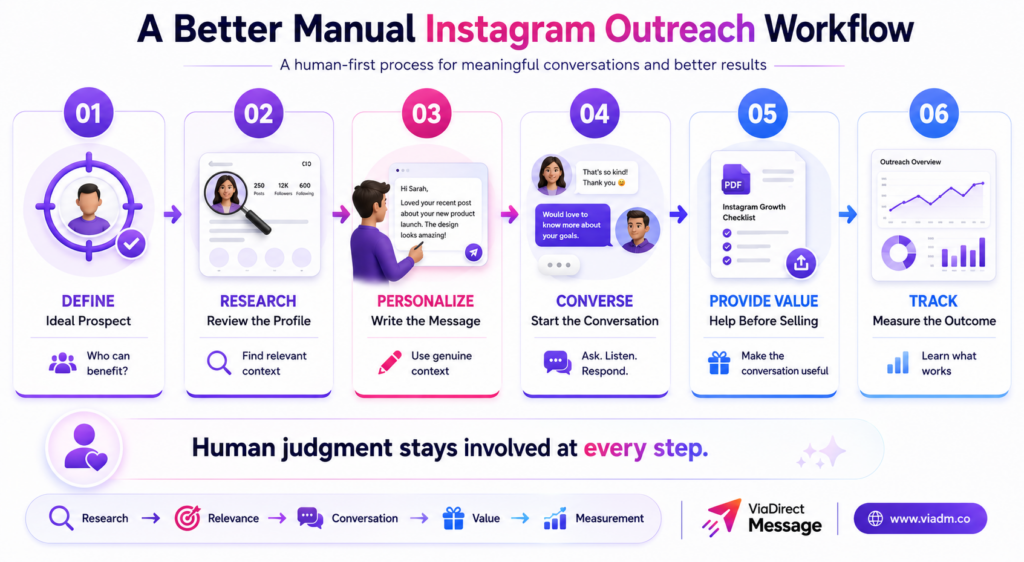
For businesses that want a repeatable process without turning Instagram communication into robotic behavior, a manual workflow can be highly effective.
Step 1: Define Your Ideal Prospect
Identify:
- Industry
- Location, if relevant
- Business size
- Role
- Problem you solve
- Buying signals
Step 2: Research the Profile
Before starting a conversation, look for a genuine reason to contact the person.
Check their recent content, business offering, positioning, and current activity.
Step 3: Start a Relevant Conversation
Use one clear observation or question.
Avoid introducing your entire product immediately.
Step 4: Listen to the Response
The recipient’s answer should determine what you say next.
If they mention a challenge, address that challenge.
If they are not interested, respect it.
Step 5: Provide Relevant Value
Share a useful idea, resource, recommendation, or explanation when appropriate.
Step 6: Qualify Naturally
Once there is genuine interest, you can discuss requirements, budget, timing, or the next step.
Step 7: Record the Outcome
Track whether the conversation became:
- No response
- Not interested
- Conversation
- Qualified lead
- Meeting
- Customer
This gives your marketing team useful data without relying purely on message volume.
Manual Outreach vs. Spam-Like Mass Activity
The distinction is important.
| Manual, Relevant Outreach | Spam-Like Activity |
| Researches prospects | Targets random accounts |
| Uses relevant context | Uses identical messages |
| Builds conversations | Pushes immediate sales |
| Respects responses | Continues after rejection |
| Measures qualified leads | Measures message volume only |
| Adapts to replies | Uses rigid scripts |
| Prioritizes relevance | Prioritizes scale |
Manual outreach does not mean every message has to be written from scratch.
Templates can still be useful. The difference is that the person sending the message remains responsible for reviewing, adapting, and sending the communication based on the actual conversation.
A Realistic Example of Better Outreach
Consider a small B2B design agency looking for ecommerce clients.
Instead of sending:
“Hello, we are a leading design agency. We offer website design. Please let us know if interested.”
the agency researches an ecommerce founder who recently launched a new product line.
A more relevant opening could be:
“Hi Priya, I saw the new product collection you launched this month. The product photography looks strong. Are you currently using Instagram mainly to drive traffic to the store, or are you focusing more on building brand awareness?”
If Priya replies that Instagram traffic is low, the agency now has a genuine reason to discuss the issue.
The conversation can develop naturally.
There is no need to force a sales pitch into the first message.
What About Automation?
Automation is often discussed alongside Instagram outreach, but businesses should distinguish between automated actions and legitimate manual communication.
A manual Instagram outreach process allows a person to:
- Select the prospect
- Review the profile
- Decide whether contact is relevant
- Customize the message
- Send it manually
- Read the response
- Decide how to continue
This human decision-making is fundamentally different from building a system that automatically sends repetitive messages to large numbers of accounts.
For businesses learning about Instagram sales workflows, the important question should not be “How can I send the maximum number of messages?”
A better question is:
“How can I start more relevant conversations without damaging the customer experience or account health?”
That shift in thinking leads to better marketing.
How to Measure Whether Your Outreach Is Healthy
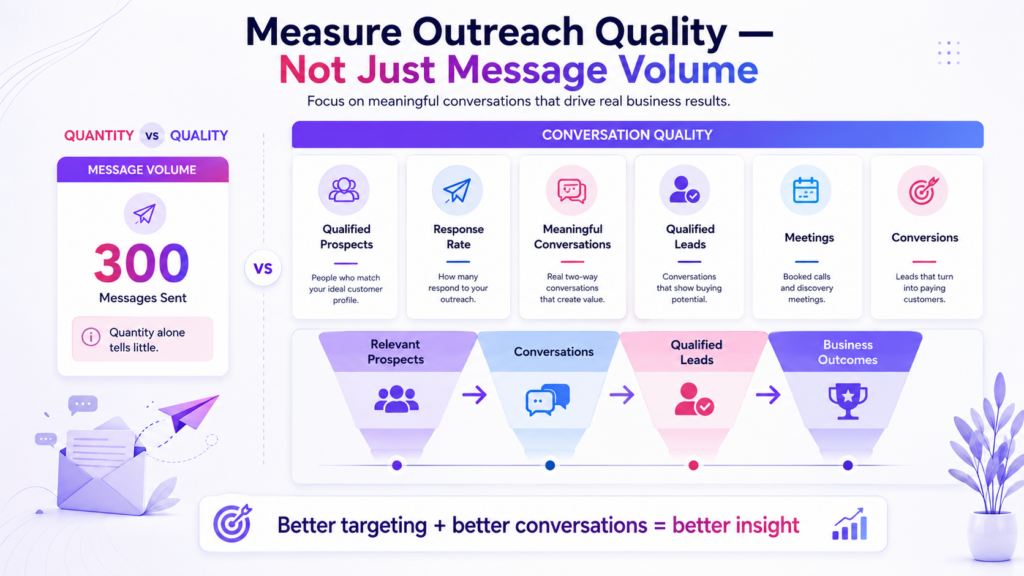
A successful outreach program should look beyond restrictions and focus on business outcomes.
A simple monthly review could include:
| Area | Question |
| Targeting | Are we reaching the right people? |
| Relevance | Are recipients responding to our topics? |
| Messaging | Which openings generate conversations? |
| Quality | Are conversations becoming qualified opportunities? |
| Feedback | Are people showing positive or negative reactions? |
| Conversion | Are conversations creating actual business value? |
If response quality is falling, sending more messages is usually not the first solution.
Review the targeting and message quality instead.
What To Do If Instagram Activity Is Restricted
If Instagram limits an account or displays a warning, do not immediately try to bypass the restriction with increasingly aggressive activity.
Instead:
- Stop questionable or repetitive activity.
- Review the relevant Instagram policy.
- Check the account’s available status information.
- Remove practices that may be causing problems.
- Give the account time to return to normal activity where appropriate.
- Use Instagram’s official support or review options when available.
The safest strategy is to correct the underlying behavior rather than trying to work around platform safeguards.
FAQ: How to Avoid Instagram Spam Detection
Can Instagram detect repetitive messages?
Instagram can use automated systems and other signals to identify behavior that may violate its policies or create a poor user experience. Repetitive messaging is therefore something businesses should avoid.
Is there a specific Instagram DM limit that guarantees safety?
There is no universal published number that guarantees an account will never encounter spam-related restrictions. Activity should be evaluated in context rather than around a supposed “safe” number.
Does personalization prevent spam detection?
No. Personalization does not guarantee that activity will never be restricted. It simply makes communication more relevant and reduces the likelihood of sending unwanted, repetitive messages.
Should businesses send the same DM to every prospect?
No. A message framework can improve consistency, but each conversation should be adapted to the prospect’s context.
Is manual Instagram outreach safer than mass automated messaging?
Manual outreach gives a person the ability to research prospects, control what is sent, respond to context, and stop when a recipient is not interested. That makes it fundamentally different from systems designed to perform repetitive messaging automatically. However, manual activity must still follow Instagram’s policies.
How many follow-ups should I send?
There is no universal number that applies to every situation. A small number of useful, context-based follow-ups is generally more appropriate than repeatedly sending “just checking in” messages.
What is the biggest mistake businesses make with Instagram outreach?
Focusing on message quantity instead of conversation quality is one of the most common mistakes. Better targeting, personalization, and relevance generally provide a stronger foundation.
Final Thoughts: Build Conversations, Not Spam
Learning how to avoid Instagram spam detection is ultimately about more than avoiding restrictions.
It is about building an Instagram outreach process that respects the people receiving your messages.
Businesses should focus on relevant prospects, personalized communication, consistent activity, useful conversations, and respectful follow-ups. They should also avoid misleading claims, repetitive messaging, irrelevant targeting, and attempts to bypass Instagram’s safeguards.
The strongest Instagram outreach strategy is not necessarily the one that sends the most messages.
It is the one that creates the most meaningful conversations with the right people.
For businesses building a structured manual outreach process, combining prospect research, personalized messaging, human review, and clear performance tracking can make Instagram a more sustainable part of their sales strategy. A focused manual Instagram outreach approach can be useful when the priority is having genuine one-to-one conversations rather than treating outreach as a race for message volume.
The practical rule is simple:
Be relevant. Be human. Be consistent. Respect the recipient.
That is the foundation of sustainable Instagram marketing—and one of the most practical ways to reduce spam-like behavior while building better business relationships.