Instagram has become much more than a platform for sharing photos and short videos. For many businesses, it is now a place where discovery, trust, conversations, and sales happen in the same environment.
A potential customer may discover a product through a Reel, visit a profile, ask a question through Direct Messages, and make a purchase without ever leaving Instagram. That makes Instagram DMs for business an important part of a modern customer acquisition strategy.
However, successful DM marketing is not about sending the largest possible number of messages. It is about starting relevant conversations with the right people, providing useful information, and making the next step easy.
Businesses that want a more structured approach can explore a manual Instagram outreach platform to organize personalized conversations while keeping the actual outreach human and intentional.
This guide explains how to use Instagram DMs for business to generate conversations and sales, what mistakes to avoid, and how to adapt message templates for different situations.
Why Instagram DMs for Business Can Drive Sales
Traditional advertising creates exposure, but a DM can create a conversation.
That difference is important.
When someone replies to a business message, the interaction becomes two-way. You can understand the person’s needs, answer questions, share relevant information, and determine whether your product or service is actually suitable.
Instagram DMs can be particularly useful for:
- E-commerce businesses
- Coaches and consultants
- SaaS companies
- Agencies
- Local businesses
- Personal brands
- Creators selling products or services
- B2B companies targeting niche audiences
For example, imagine a small fitness brand that notices someone regularly engaging with its educational content. Instead of immediately sending a sales pitch, the brand can start a conversation around the person’s interest in fitness equipment or training.
That creates a much more natural path from attention to consideration.
The real value is conversation, not message volume
Sending 500 irrelevant DMs does not automatically create better results than sending 50 carefully researched messages.
A useful way to think about Instagram outreach is:
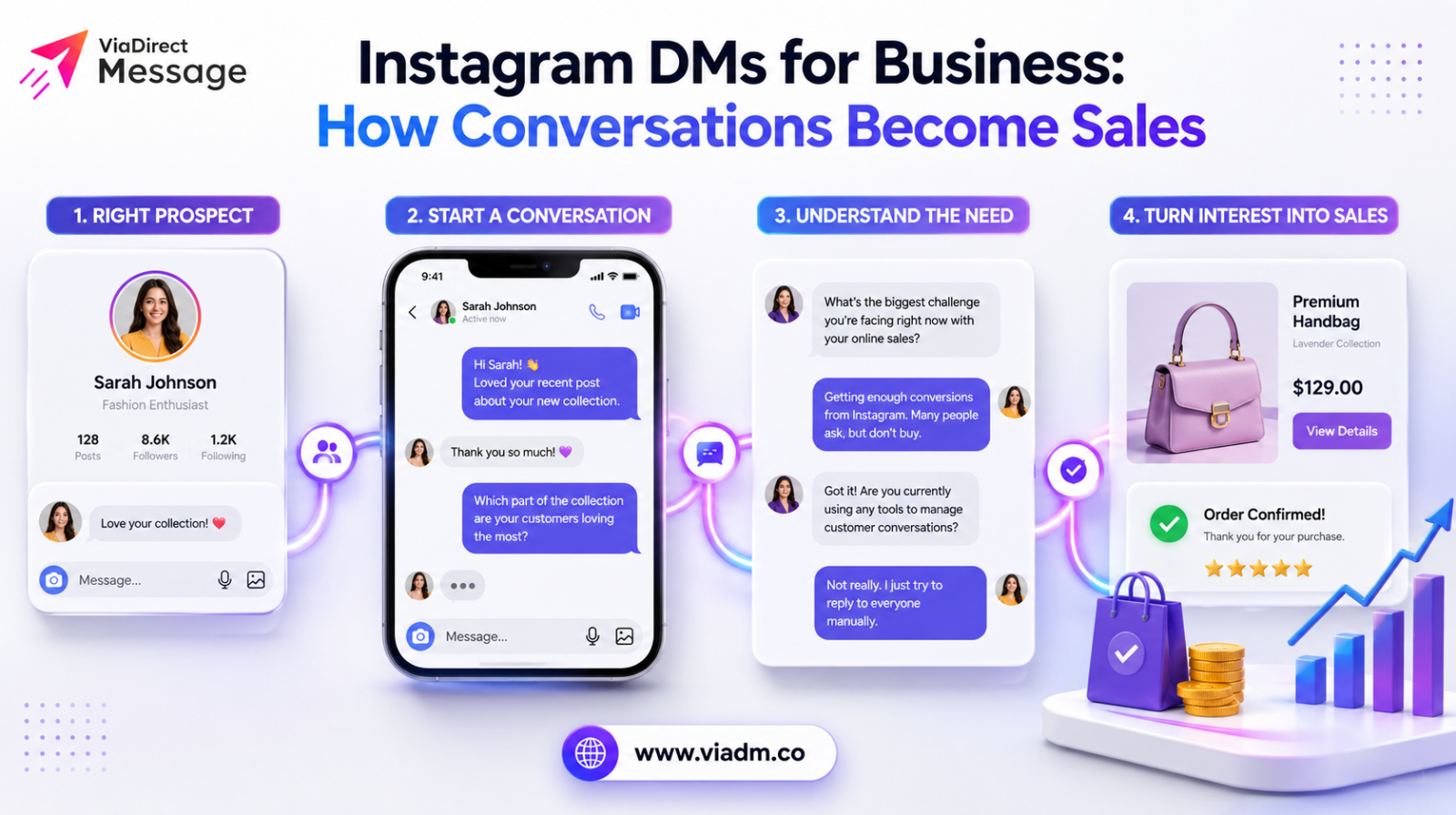
Relevant prospect → Personalized message → Conversation → Qualification → Helpful recommendation → Sales opportunity
The DM is only the beginning.
How to Build an Instagram DM Sales Strategy
Before writing your first message, define what you want the conversation to achieve.
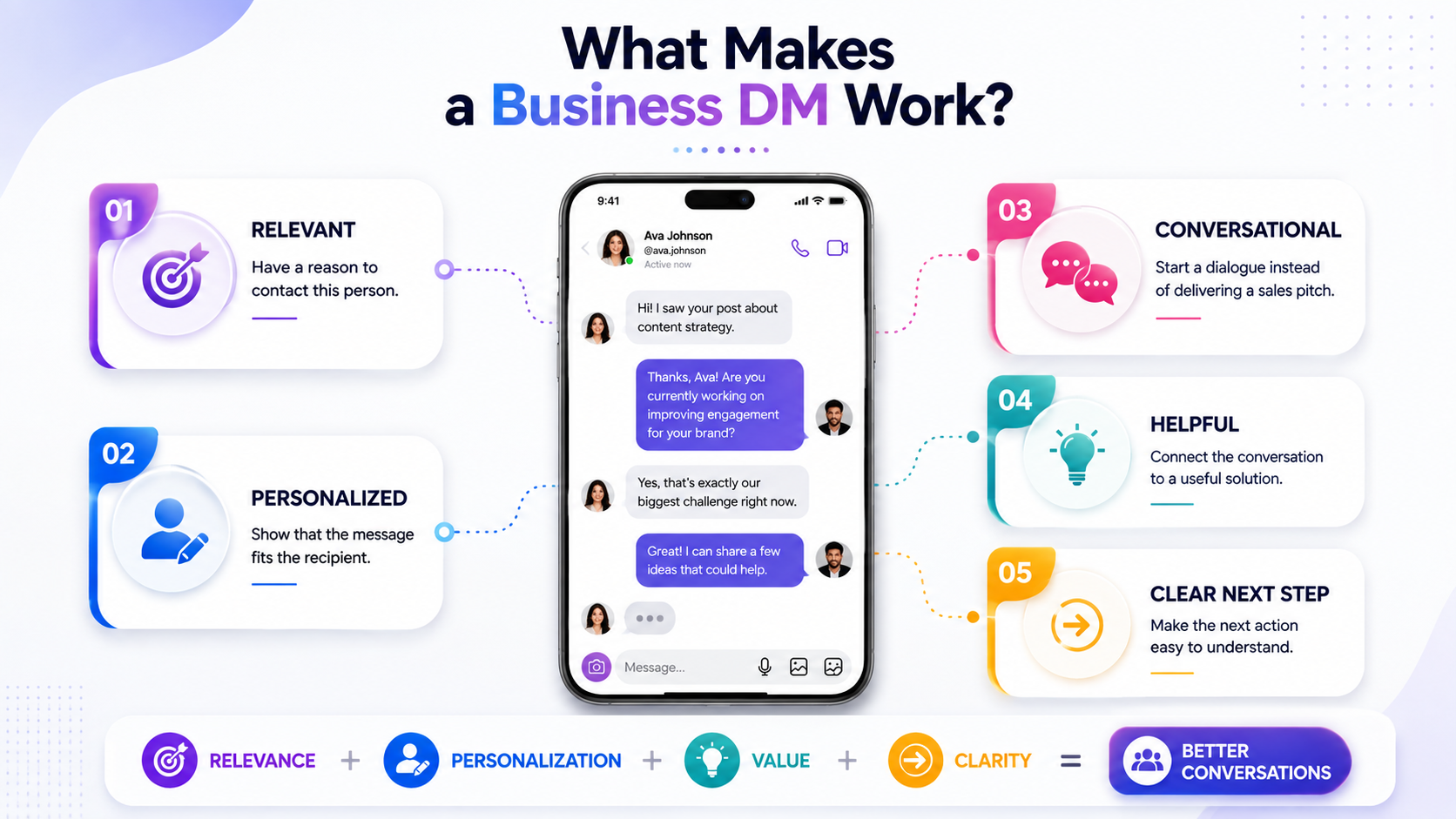
A strong Instagram DM strategy usually has five components:
- Identify the right audience.
- Find a relevant reason to start a conversation.
- Personalize the opening message.
- Provide value before pushing the sale.
- Follow up appropriately.
Skipping the first two steps often creates the biggest problem: messages that feel random.
1. Define your ideal customer
Start by identifying who is most likely to benefit from your offer.
Consider:
- Industry
- Location
- Job role
- Interests
- Buying intent
- Existing engagement
- Business size
- Common problems
- Products or services they already use
For instance, a web development agency shouldn’t message every Instagram account it finds. It could instead identify growing businesses with active Instagram profiles but outdated websites.
That gives the outreach a genuine reason.
2. Look for conversation triggers
A conversation trigger is something that makes your message relevant to that particular person.
Examples include:
- They commented on a relevant post.
- They followed your account.
- They asked a question publicly.
- They mentioned a problem your product solves.
- They recently launched a product.
- They posted about a relevant business challenge.
- They engaged with educational content.
A message based on an observable action usually feels more natural than a generic sales pitch.
3. Personalize the opening
Personalization does not mean adding someone’s first name to a copied template.
Real personalization explains why you contacted that specific person.
Instead of:
Hi Sarah, we offer premium marketing services. Would you like to know more?
Try:
Hi Sarah, I saw your recent post about expanding your online store. The way you’re positioning the new collection looks interesting. Are you currently focusing more on Instagram traffic or repeat customers?
The second message gives the recipient something meaningful to respond to.
Instagram DM Message Templates for Business
Templates can save time, but they should be treated as frameworks rather than messages that are copied and sent unchanged.
Here are practical templates for different stages of a customer conversation.
Template 1: New Prospect Introduction
Hi [Name], I came across your profile while looking at businesses in [industry]. I noticed [specific observation]. Curious — are you currently working on improving [relevant goal]?
This works because it starts with context rather than a product pitch.
Template 2: Engaged Follower
Hey [Name], thanks for checking out our recent post about [topic]. I noticed you’re interested in [relevant subject]. Is that something you’re currently working on?
The recipient already interacted with your content, so the conversation has a natural starting point.
Template 3: Product Recommendation
Thanks for sharing that. Based on what you mentioned, I think [product/service] could be relevant because it helps with [specific benefit]. If you’d like, I can show you how it works.
Notice the wording: “could be relevant” is less aggressive than making an unsupported claim that the product is perfect for them.
Template 4: Soft Sales Message
From what you’ve described, I think there may be a good fit here. Would you like me to send over a quick overview of how it works and what it typically costs?
This gives the prospect control over the next step.
Template 5: Follow-Up
Hi [Name], just wanted to follow up on our conversation about [topic]. No pressure at all — if it’s still something you’re exploring, I’m happy to answer any questions.
A follow-up should make it easy for someone to respond without feeling pressured.
The Difference Between Personalization and Spam
One of the most important lessons in Instagram DM marketing is that personalization is not simply about inserting variables into a template.
Compare these two approaches.
Generic:
Hi! We help businesses grow. Are you interested?
Contextual:
Hi! I noticed you’re promoting your new skincare collection through Reels. Are you currently using Instagram mainly for awareness, or are you also trying to turn those conversations into customers?
The second message demonstrates that someone actually looked at the account.
That matters because recipients are more likely to engage when they understand why the message was sent.
Instagram’s own Help Center guidance on messaging and account interactions is also useful when developing outreach practices and understanding how the platform handles interactions.
A Simple DM Funnel That Moves People Toward a Sale
A good Instagram DM sales process does not need to be complicated.
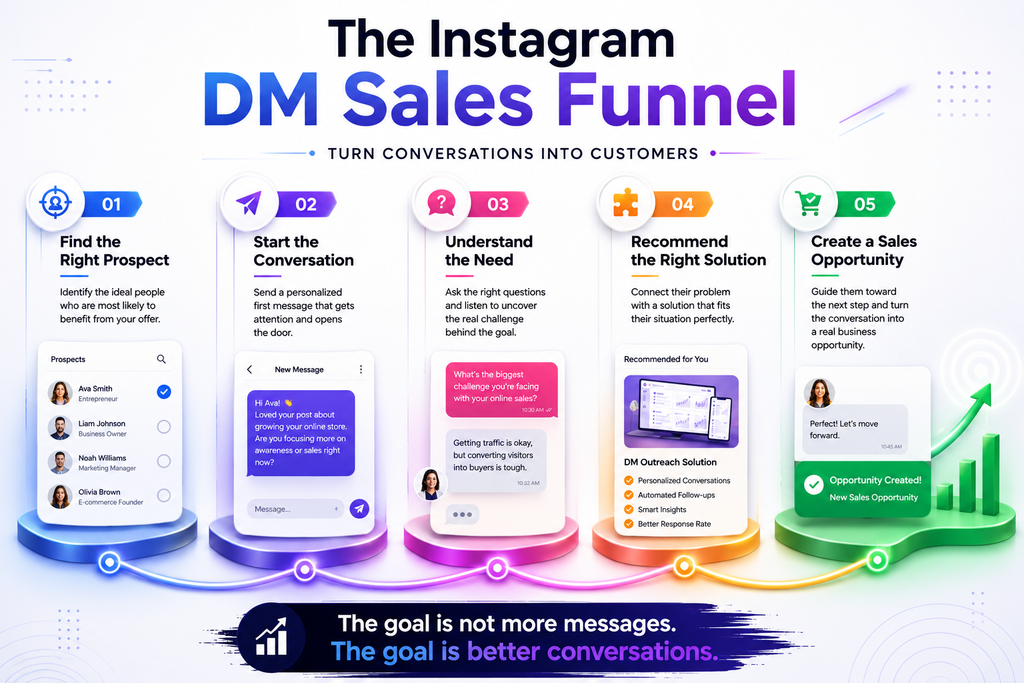
You can structure it into four stages.
Stage 1: Start the conversation
The first message should have one purpose: earn a response.
Don’t try to explain your entire company in the opening DM.
A short, relevant question is usually easier to answer.
Stage 2: Understand the need
Once the person responds, ask questions.
For example:
What are you currently using to handle that?
Or:
What’s the biggest challenge you’re facing with it right now?
This stage is important because you should understand the customer’s situation before recommending a solution.
Stage 3: Connect the problem to your offer
Once you understand the need, explain how your product or service addresses it.
For example:
That makes sense. In that situation, our approach focuses on organizing personalized conversations so your team can spend less time managing scattered outreach and more time having relevant conversations.
The explanation should be connected directly to what the prospect told you.
Stage 4: Offer a clear next step
Don’t leave the conversation without direction.
The next step could be:
- View a product
- Book a call
- Request pricing
- Try a free resource
- See a demonstration
- Visit a landing page
- Continue the conversation
A simple question often works:
Would you like me to send you the details?
How to Follow Up Without Becoming Pushy
Following up is necessary because people are busy.
However, repeated messages without adding context can quickly become annoying.
Instead of:
Hey, following up.
Try:
Hi [Name], following up on our conversation about [specific topic]. I found a quick resource that explains the approach we discussed, so I thought it might be useful.
This gives the follow-up a reason to exist.
You can also use different follow-up angles:
First follow-up: Clarify the previous conversation.
Second follow-up: Share useful information.
Final follow-up: Give the person an easy opportunity to close the conversation.
For example:
I don’t want to keep filling your inbox, so I’ll leave it here. If improving [specific problem] becomes a priority later, feel free to reach out.
That approach protects the relationship even when there is no immediate sale.
Manual Outreach vs. Mass Messaging
There is an important distinction between structured outreach and indiscriminate mass messaging.
Businesses often need tools to organize prospects, conversations, and outreach activity. However, organization does not have to mean removing the human element from communication.
For example, a platform such as ViaDM’s Instagram outreach solution can support a manual outreach workflow where businesses identify prospects and send personalized messages themselves.
The difference is important:
Manual outreach
- Human-written conversations
- Prospect-specific personalization
- Intentional message selection
- Human control over what is sent
- More attention to conversation quality
Low-quality mass outreach
- Same message sent repeatedly
- Little prospect research
- Generic sales pitches
- Excessive messaging
- Focus on volume instead of relevance
For businesses building a sustainable Instagram sales process, conversation quality should remain more important than raw sending volume.
What Makes an Instagram DM Convert?
There is no universal conversion rate that every business should expect.
Results vary significantly based on audience quality, offer, industry, account reputation, message relevance, timing, and the quality of the sales process after someone replies.
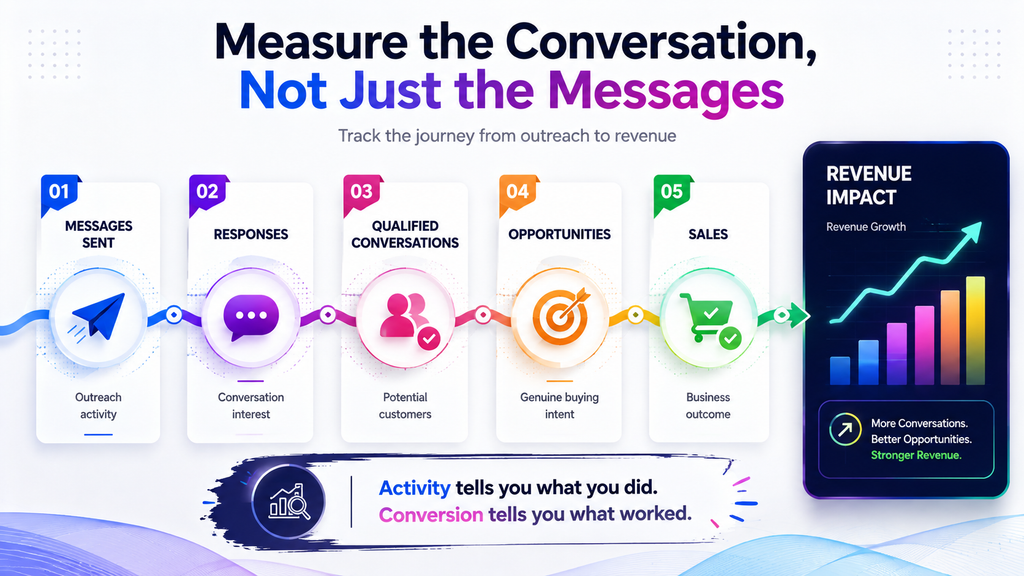
Instead of focusing on one industry-wide benchmark, measure your own funnel.
A useful internal dashboard can include:
| Metric | What It Tells You |
|---|---|
| Messages sent | Outreach activity |
| Responses | Conversation interest |
| Response rate | Message relevance |
| Qualified conversations | Sales potential |
| Offers presented | Sales opportunities |
| Meetings or demos | Buying intent |
| Purchases | Revenue impact |
| Revenue per conversation | Commercial efficiency |
For example, suppose a campaign reaches 200 carefully selected prospects. If 36 respond, 14 become qualified conversations, 6 request more information, and 2 become customers, the business can analyze each stage rather than simply saying that “DMs worked.”
This type of measurement helps identify where improvement is actually needed.
If responses are low, improve the opening message or targeting.
If responses are strong but purchases are weak, examine qualification, offer positioning, pricing, or the sales process.
A Practical Example: Turning Engagement Into a Sales Conversation
Consider a hypothetical B2B software company targeting small online retailers.
The company notices that several store owners regularly engage with its educational Instagram content about customer retention.
Instead of sending:
We have a software solution for your business. Book a demo.
The company could start with:
Hey [Name], thanks for engaging with our post about repeat purchases. I noticed you’re running an online store in the fashion space. Are you currently doing anything specific to bring previous customers back?
If the prospect says they mainly rely on promotional emails, the conversation can move naturally toward retention strategies.
Only after understanding the situation should the business explain its product.
The important point is that the product was not the opening topic.
The customer’s problem was.
That distinction can dramatically change how a sales conversation feels.
Common Instagram DM Mistakes Businesses Should Avoid
Even a good strategy can fail when execution is poor.
Sending the same message to everyone
A template can be useful. A completely identical message sent to unrelated prospects usually isn’t.
Adapt the opening based on the recipient’s context.
Making the first message too long
People don’t want to read a sales brochure inside their inbox.
Keep the opening concise and give the person one clear reason to respond.
Pitching before understanding
If someone has not explained their situation, you may not know whether your product is relevant.
Ask questions first.
Overusing links
Dropping a website link immediately can make the message look promotional.
A better approach is to establish context first and share a relevant resource when it genuinely helps the conversation.
Measuring only messages sent
A large sending number is not a sales metric.
Track responses, qualified conversations, opportunities, and revenue as well.
Ignoring negative signals
If someone clearly indicates they are not interested, respect that decision.
Long-term brand trust is more valuable than forcing one additional conversation.
How to Create Better Instagram DM Campaigns
A repeatable process can make outreach much easier to manage.
Step 1: Build a focused prospect list
Start with a narrow audience rather than trying to reach everyone.
Step 2: Research before messaging
Spend enough time understanding why the person may be relevant.
Step 3: Prepare conversation frameworks
Create several templates for different situations, such as:
- New prospect
- Engaged follower
- Product inquiry
- Referral
- Follow-up
- Re-engagement
Step 4: Personalize the important parts
The opening sentence and reason for contacting someone should reflect the individual.
Step 5: Track outcomes
Record meaningful results rather than only activity.
Step 6: Improve based on evidence
If one message consistently generates better conversations, study why it works.
Then improve the strategy rather than simply increasing volume.
For businesses that want to explore more practical Instagram outreach strategies, the Instagram marketing resources can provide additional ideas for building a structured approach to direct conversations.
How AI and Automation Fit Into the Future of DM Marketing
Technology can help businesses organize data, identify prospects, analyze performance, and manage workflows.
However, businesses should distinguish between using technology for organization and replacing human communication entirely.
For sales conversations where context and trust matter, human judgment remains valuable.
A practical workflow might look like this:
Research → Organize → Personalize → Manually Message → Converse → Qualify → Convert → Measure
Technology can support several parts of this process without turning every interaction into an automated message.
This is particularly important for brands where the quality of the relationship affects purchasing decisions.
Free Instagram DM Templates You Can Adapt
Here is a compact template library for common business situations.
- When someone engages with your content
Thanks for checking out our post about [topic]. Curious — is [topic] something you’re currently working on?
- When approaching a potential customer
Hi [Name], I came across your profile while researching [industry]. I noticed [specific observation]. Are you currently focused on improving [specific area]?
- When someone asks about your product
Absolutely. Based on what you’re looking for, [product/service] may be a good fit because it helps with [specific benefit]. Would you like me to share the details?
- When a prospect shows interest
Great. Before I send everything over, can I ask what you’re currently using for [problem]? That will help me point you toward the most relevant option.
- When following up
Hi [Name], just checking back on our conversation about [topic]. If you’re still exploring it, I’m happy to answer any questions.
- When closing an inactive conversation
I’ll leave it here for now so I don’t keep filling your inbox. If [specific goal] becomes a priority later, feel free to message me anytime.
These templates work best when they are adapted to the actual conversation.
How to Make Instagram DMs More Human
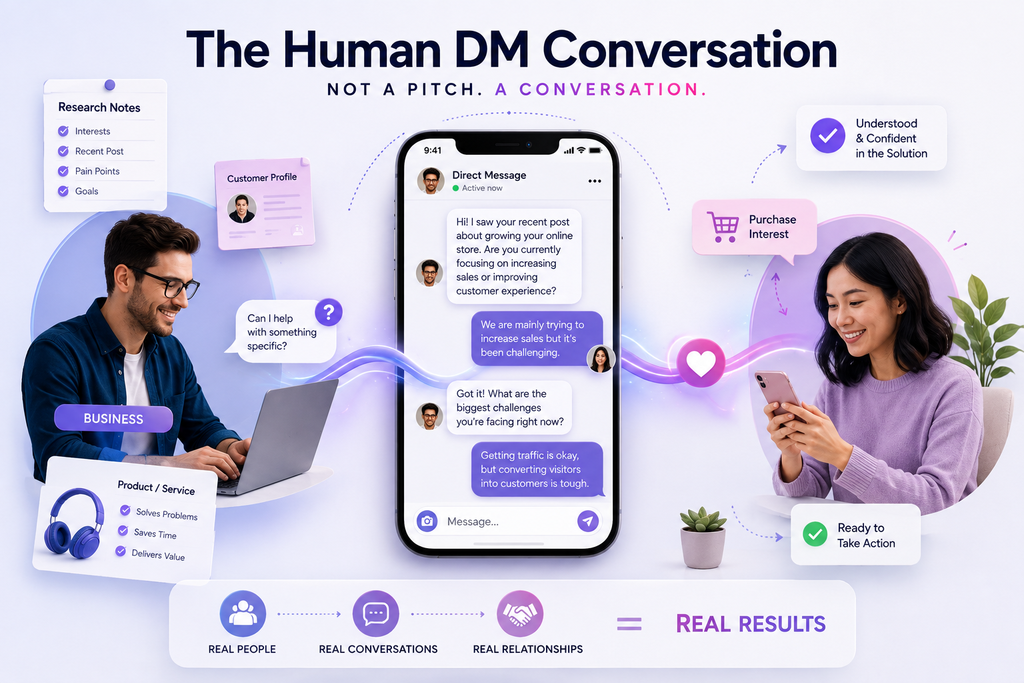
The best business DMs often sound surprisingly simple.
You don’t need complicated sales language.
You need:
- A relevant reason to reach out
- A clear question
- Genuine interest
- Useful information
- Respect for the recipient’s time
- A logical next step
Think about how you would speak to someone at a professional networking event.
You wouldn’t walk up and immediately read your entire sales pitch.
You would introduce yourself, find common ground, ask a question, listen, and continue the conversation.
Instagram DMs should work in much the same way.
Frequently Asked Questions About Instagram DMs for Business
Can Instagram DMs really generate sales?
Yes. DMs can contribute to sales when they are used to start relevant conversations with qualified prospects. However, results depend on targeting, offer quality, messaging, follow-up, and the overall sales process.
How long should a business DM be?
There is no universal character limit that guarantees conversions. In general, the opening message should be short enough to understand quickly and specific enough to explain why you are contacting the person.
Should businesses use DM templates?
Yes, templates can make outreach more consistent and efficient. However, they should be adapted to the recipient instead of being copied word-for-word for everyone.
How many DMs should a business send per day?
There is no single number that is appropriate for every account. Businesses should prioritize relevance, recipient response, account health, and Instagram’s current platform policies rather than chasing an arbitrary volume target.
Is manual Instagram outreach still useful?
Yes. Manual outreach can be particularly useful when personalization and conversation quality are important. It gives businesses direct control over the messages they send and how they respond to prospects.
What should I track?
At minimum, track messages sent, responses, qualified conversations, opportunities, conversions, and revenue. These metrics provide a clearer picture than message volume alone.
Should the first DM include a sales link?
Not necessarily. If the person has not shown buying intent, starting a conversation may be more effective than immediately sending a promotional link. Share resources when they are relevant to the conversation.
Final Thoughts: Turn Instagram Conversations Into Business Opportunities
Instagram DMs for business are most effective when they are treated as conversations rather than advertisements.
The goal isn’t to send more messages simply because you can. The goal is to identify the right people, understand their needs, communicate clearly, and create a useful next step.
A strong strategy combines:
Relevant targeting + personalized openings + genuine conversations + thoughtful follow-ups + measurable outcomes
Businesses can use templates to improve consistency, but the human context behind each conversation should remain important.
As your outreach becomes more structured, a manual Instagram outreach approach for personalized business conversations can help keep prospecting organized without treating every customer interaction as an automated exchange.
Ultimately, the brands that get the most value from Instagram DMs are not necessarily the ones sending the most messages. They are the ones creating the most relevant conversations.