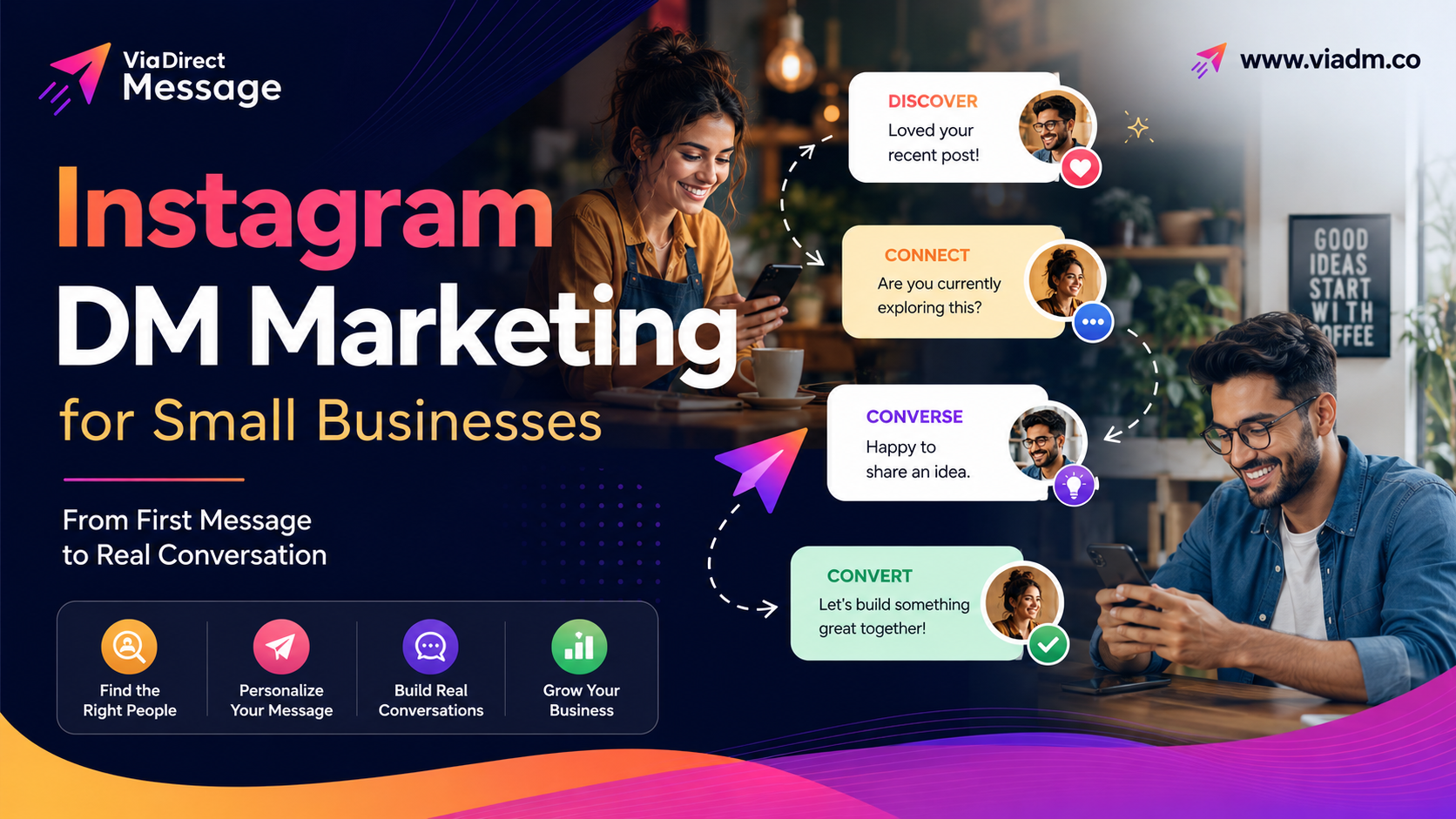
Instagram is no longer just a platform for sharing photos, Reels, and Stories. For small businesses, it can also become a practical channel for starting conversations with potential customers, building relationships, answering questions, and turning warm interest into genuine business opportunities.
However, successful Instagram outreach is not about sending the largest possible number of messages. It is about sending the right message to the right person at the right time.
That is where Instagram DM marketing for small businesses becomes especially useful. A local service provider, ecommerce brand, consultant, creator, agency, or B2B company can use Instagram conversations to understand prospects, provide relevant information, and move interested people toward the next step.
For businesses that prefer a human-led approach, manual Instagram outreach can help organize personalized conversations without treating every prospect like a number. The objective is simple: start useful conversations instead of pushing generic sales pitches.
This guide explains how small businesses can build an Instagram DM marketing strategy from the ground up, including prospect research, message writing, follow-ups, personalization, measurement, common mistakes, and practical examples.
What Is Instagram DM Marketing?
Instagram DM marketing is the practice of using Instagram Direct Messages to communicate directly with existing followers, potential customers, creators, partners, or other relevant audiences.
Unlike public posts, DMs create a private communication channel. This makes them particularly useful when a business needs to discuss a specific product, answer a question, qualify interest, or build a professional relationship.
A good DM strategy usually combines:
- Audience research
- Relevant prospect selection
- Personalized opening messages
- Genuine conversation
- Helpful follow-ups
- Clear calls to action
- Performance tracking
- Continuous improvement
The important distinction is between conversation-based outreach and mass messaging.
A small business does not need thousands of messages to generate meaningful opportunities. In many situations, a smaller number of carefully researched conversations can produce better-quality interactions.
Why Instagram DM Marketing Works for Small Businesses
Small businesses often compete with larger companies that have bigger advertising budgets and dedicated marketing teams. Instagram DMs offer another route: direct, personal communication.
A potential customer may ignore a generic advertisement but respond to a thoughtful message that clearly relates to something they posted, asked about, or showed interest in.
For example, imagine a boutique fitness studio identifying Instagram users who regularly post about running and fitness. Instead of immediately sending:
“Hi! Buy our membership today. We have a special discount.”
A more useful approach could begin with a relevant conversation:
“Hi Sarah, noticed you’ve been sharing your running progress recently. Are you currently training independently, or do you follow a structured program?”
The second message does not immediately force a sale. It creates an opportunity to understand the person’s situation.
That difference matters.
Instagram DM marketing for small businesses works best when the conversation feels like a conversation—not an advertisement copied into a private inbox.
Step 1: Define Your Instagram DM Marketing Goal
Before sending a single message, decide what the campaign is supposed to accomplish.
Different businesses may have completely different objectives.
Common goals include:
- Generating qualified leads
- Booking consultations
- Increasing product inquiries
- Promoting a new service
- Reconnecting with previous prospects
- Finding collaboration opportunities
- Recruiting affiliates or creators
- Collecting customer feedback
- Building relationships with potential partners
- Driving qualified traffic to a landing page
Your goal determines your audience, message, call to action, and measurement strategy.
For example, an ecommerce brand might measure product inquiries and sales conversations, while a consultant may care more about booked discovery calls.
Avoid using “send more DMs” as the primary goal. Message volume is an activity metric. Business conversations and qualified outcomes are what ultimately matter.
Step 2: Identify the Right Instagram Prospects
The quality of your prospect list can have a greater impact than the number of messages you send.
Start by defining your ideal customer.
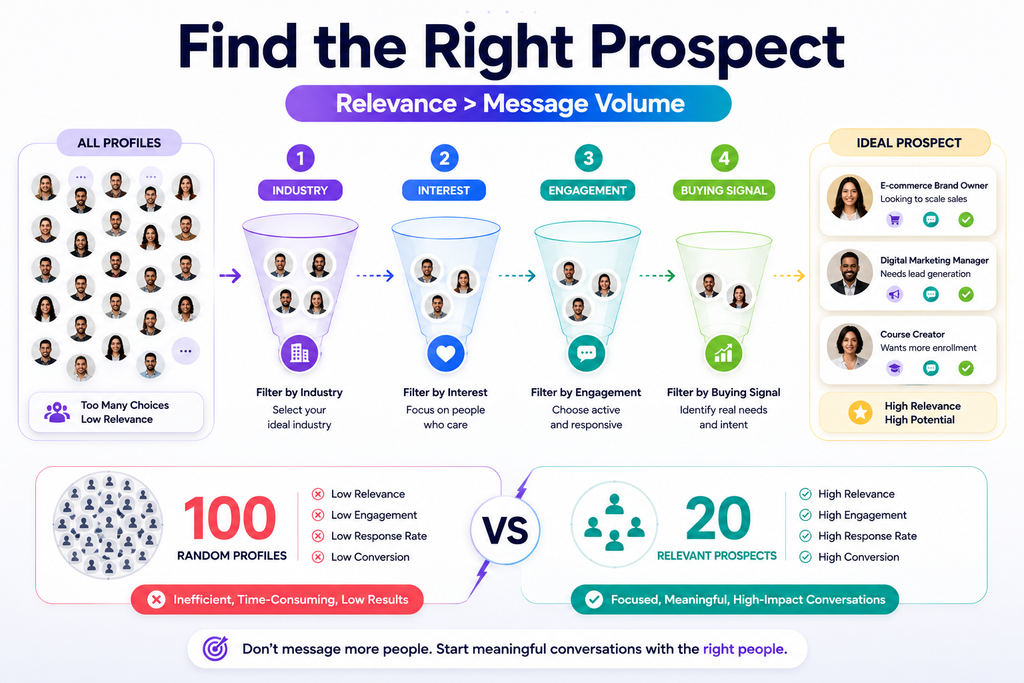
Consider:
- Industry
- Location
- Job or business type
- Interests
- Typical problems
- Buying signals
- Content engagement
- Existing relationship with your brand
Then look for accounts that match those characteristics.
Look for buying or interest signals
Not every follower is equally valuable.
Useful signals may include:
- Someone asking questions about a product category
- A business owner discussing a problem your service solves
- A creator looking for brand partnerships
- A user interacting with relevant industry content
- A potential customer commenting about a need
- Someone who has already engaged with your profile
These signals give you a reason to start a conversation.
For instance, a web design studio targeting small restaurants could prioritize restaurant owners who are actively posting about their business but have recently mentioned website, booking, or customer-acquisition challenges.
That is much more relevant than selecting random restaurant accounts.
Step 3: Research the Prospect Before Sending a DM
One of the biggest mistakes in Instagram DM marketing for small businesses is skipping research.
A few minutes of context can dramatically improve the quality of an opening message.
Review:
- Their profile description
- Recent posts
- Recent Stories, where appropriate
- Business website
- Products or services
- Recent announcements
- Relevant interests
- Previous interaction with your account
The goal is not to investigate someone’s entire online history. It is simply to understand enough context to make your message relevant.
A simple research framework
Before contacting a prospect, ask:
Who are they?
Understand their role, business, or interest.
What are they currently doing?
Look at recent activity rather than relying only on an old bio.
What could you genuinely help with?
Your message should connect their situation with something useful.
Why am I contacting this person specifically?
If you cannot answer this question, the prospect may not be qualified enough for outreach.
Step 4: Write a DM That Sounds Human
Your first message has one main job: start a relevant conversation.
It does not have to close a sale.
A useful structure is:
Context → Relevance → Simple Question
For example:
“Hi James, I came across your recent post about expanding your local catering business. It looks like you’re already getting good engagement from corporate events. Are you currently doing anything specific to generate more corporate inquiries through Instagram?”
This works better than immediately sending a long product pitch because it demonstrates context.
Keep the opening message simple
Avoid:
- Long introductions
- Multiple links
- Large blocks of promotional text
- Excessive emojis
- Fake urgency
- Generic compliments
- Claims that sound too good to be true
- Copy-pasted messages with only the person’s name changed
Instead, focus on one relevant observation and one natural question.
Step 5: Personalize Without Overcomplicating It
Personalization does not mean writing a completely different essay for every prospect.
A practical approach is to create a message framework while customizing the most important part: why you are contacting that particular person.
For example:
Template structure
Hi [Name], noticed [specific relevant observation].
Curious—[simple question related to their situation]?
The first sentence establishes context. The second encourages a response.
- For a photographer, the observation might relate to their recent wedding portfolio.
- For a SaaS founder, it could relate to a recent product launch.
- For a local restaurant, it could relate to a new menu or location.
The message framework can remain consistent while the meaningful context changes.
Step 6: Start the Conversation Before Presenting the Offer
One of the most important principles in Instagram DM marketing for small businesses is conversation before conversion.
If someone responds, do not immediately send a pricing page, sales deck, or five-paragraph explanation unless they have shown interest.
Instead, understand their situation.
A simple conversation may follow this path:
Prospect:
“We’re mostly getting customers through referrals right now.”
Business:
“That makes sense. Are you looking to add another acquisition channel, or are referrals working well for your current growth target?”
Now the business has learned something useful.
If the prospect says they want another channel, the conversation can naturally move toward a relevant solution.
This approach also helps prevent businesses from pitching services that the prospect does not actually need.
Step 7: Use Follow-Ups Carefully
Not every prospect will respond to the first message.
People are busy. They may see the message later, forget to respond, or simply need more context.
A follow-up can be appropriate, but it should add value rather than create pressure.
For example:
“Hi James, just following up on my earlier message. I noticed you’re continuing to promote your corporate catering work. If generating more business inquiries from Instagram is something you’re exploring, happy to share a few ideas.”
This is different from repeatedly sending:
“Hi?”
“Did you see my message?”
“Please reply.”
“Last chance!”
A thoughtful follow-up respects the recipient’s attention.
A practical follow-up framework
Consider a small sequence such as:
- Relevant opening message
- Follow-up with additional context
- Final low-pressure follow-up
After that, stop pursuing the conversation if there is no meaningful response.
Quality matters more than persistence.
Step 8: Keep Outreach Manual and Human-Led
For small businesses that prioritize personalized communication, a manual workflow can be valuable because the person sending the message can review the prospect and adjust the conversation based on context.
This is particularly useful when the objective is relationship building rather than simply maximizing message volume.
A platform such as a manual Instagram messaging workflow for personalized outreach can support businesses that want a more organized way to manage direct conversations while keeping the actual outreach human-led.
The distinction is important: ViaDM should be understood as a manual Instagram outreach platform, not an automation tool.
That means the strategy remains centered around human judgment:
- Who should be contacted?
- Why are they relevant?
- What should be said?
- How should the conversation continue?
- When should the business stop following up?
Technology can help organize a process, but relevance and judgment still come from the person running the outreach.
Step 9: Track the Right Instagram DM Metrics
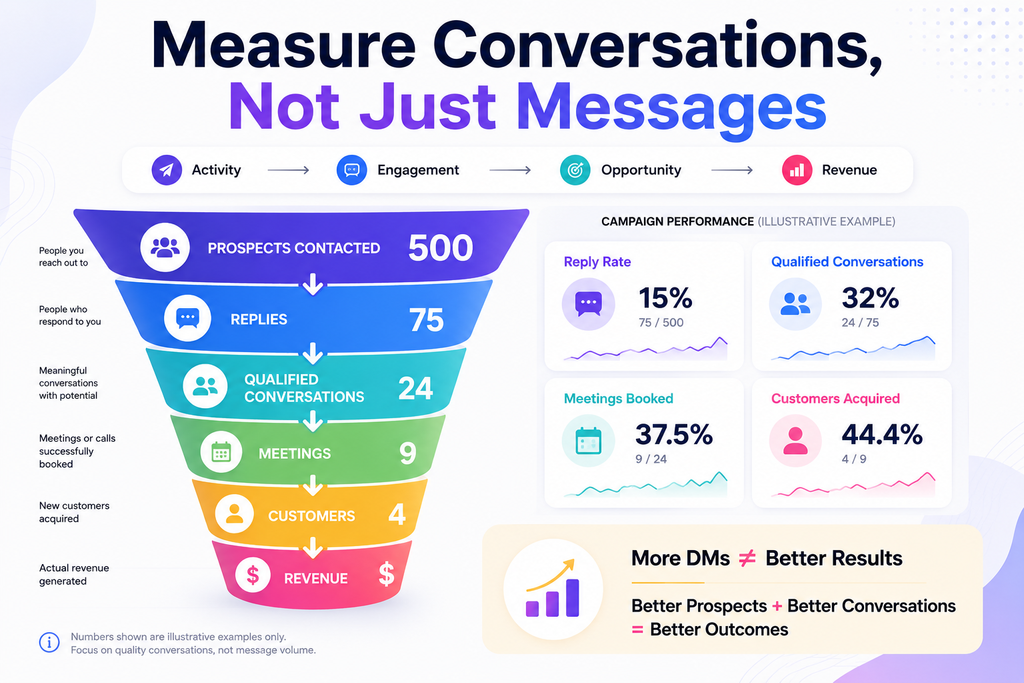
If you want Instagram DM marketing for small businesses to become a repeatable marketing channel, track results.
Do not focus only on the number of DMs sent.
A simple performance table can include:
| Metric | What It Tells You |
|---|---|
| Prospects contacted | Outreach activity |
| Replies | Initial engagement |
| Qualified conversations | Lead quality |
| Positive responses | Message relevance |
| Calls or meetings booked | Conversion intent |
| Opportunities created | Business value |
| Customers acquired | Final outcome |
| Revenue generated | Commercial impact |
You can also calculate basic rates.
Reply Rate
Reply Rate = Replies ÷ Messages Sent × 100
Qualified Conversation Rate
Qualified Conversation Rate = Qualified Conversations ÷ Replies × 100
Meeting Conversion Rate
Meeting Conversion Rate = Meetings Booked ÷ Qualified Conversations × 100
These numbers help identify where the problem exists.
- If replies are low, improve the opening message or prospect selection.
- If replies are high but qualified conversations are low, the audience may be poorly targeted.
- If conversations are strong but meetings are rare, the offer or call to action may need improvement.
Step 10: Test One Variable at a Time
Do not completely change your strategy every few days.
Instead, test specific variables.
For example:
Test A: Opening style
Version 1: Observation-based opening
Version 2: Question-based opening
Test B: Call to action
Version 1: “Would you be interested in discussing this?”
Version 2: “Is this something you’re currently working on?”
Test C: Prospect segment
Segment 1: Small ecommerce brands
Segment 2: Local service businesses
Record the results over a meaningful sample and compare them.
This creates a more reliable learning process than judging a campaign from five or ten messages.
A Realistic Small-Business Campaign Example
Consider a hypothetical but realistic local marketing consultancy that wants to reach independent fitness businesses through Instagram.
Instead of contacting every fitness account it can find, the consultancy creates a narrower audience:
- Independent gyms
- Personal training studios
- Yoga businesses
- Pilates studios
- Businesses actively posting on Instagram
- Businesses located in selected target markets
The team then reviews each profile before starting a conversation.
One prospect recently posted about having difficulty converting Instagram engagement into trial-class bookings.
That creates a natural reason for outreach.
Rather than immediately selling marketing services, the consultant could start with a question about the challenge mentioned in the post.
If the owner responds, the consultant can explore:
- How they currently generate trial bookings
- Which Instagram content performs best
- Whether DMs already generate inquiries
- Where prospects usually drop off
- Whether they have a follow-up process
Only after understanding the situation should a relevant service be introduced.
This type of campaign can also produce qualitative insights that numbers alone cannot provide. If several business owners describe the same problem, that feedback can influence future content, offers, and positioning.
Importantly, this example is a campaign model, not a claimed customer case study or fabricated performance result.
Build a Simple Instagram DM Marketing Workflow
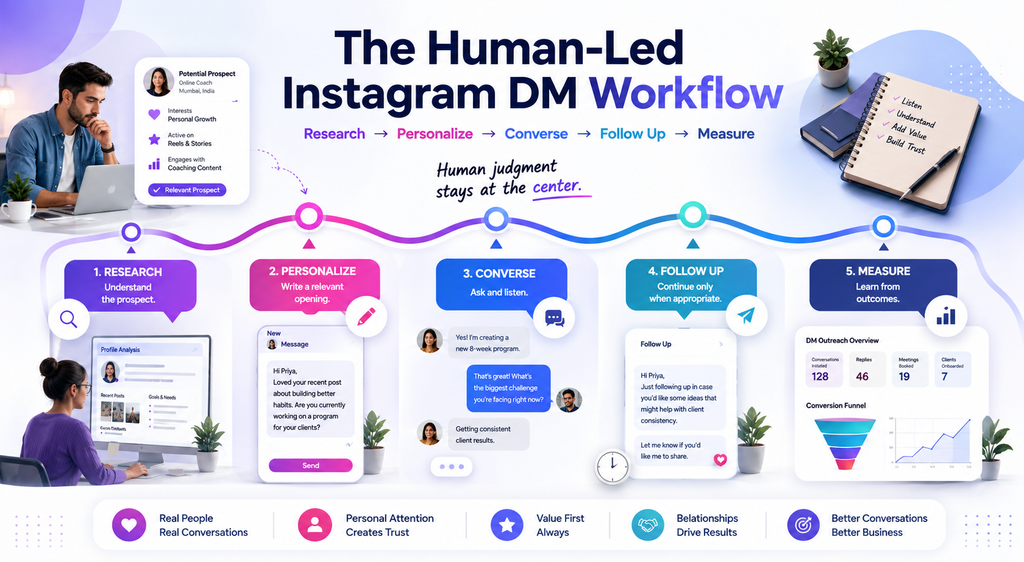
A repeatable workflow can make Instagram outreach easier to manage.
Stage 1: Research
Identify relevant accounts and record the reason each prospect is qualified.
Stage 2: Prioritize
Separate prospects into high, medium, and low relevance.
Stage 3: Personalize
Prepare a short opening based on genuine context.
Stage 4: Start the conversation
Send the opening message manually and allow the prospect to respond naturally.
Stage 5: Qualify
Ask questions that determine whether the prospect has a relevant need.
Stage 6: Provide value
Share an appropriate insight, resource, answer, or recommendation.
Stage 7: Present the offer
Only when the conversation indicates a reasonable fit.
Stage 8: Follow up
Use respectful, limited follow-ups when appropriate.
Stage 9: Record the outcome
Track whether the conversation became qualified, inactive, booked, converted, or closed.
This workflow turns Instagram DMs from an informal activity into a measurable marketing process.
Common Instagram DM Marketing Mistakes
Even a well-designed strategy can fail when execution becomes too aggressive.
Sending the Same Message to Everyone
A generic message makes it difficult for the recipient to understand why they were contacted.
Better approach: Keep your process structured but personalize the reason for contacting each prospect.
Pitching Too Early
A sales pitch before understanding the prospect can make the conversation feel transactional.
Better approach: Ask a relevant question first.
Ignoring the Prospect’s Profile
If someone clearly states what they do, sending a message asking exactly what they do demonstrates a lack of research.
Better approach: Spend enough time reviewing the profile to understand the context.
Measuring Only Message Volume
Sending more messages does not automatically mean generating more business.
Better approach: Track replies, qualified conversations, meetings, customers, and revenue.
Over-Following Up
Repeated messages can damage the relationship.
Better approach: Keep follow-ups limited, relevant, and respectful.
Using Misleading Claims
Avoid exaggerated promises such as guaranteed leads, guaranteed sales, or instant growth.
Professional outreach should be transparent about what the business can actually provide.
Instagram DM Marketing and Customer Trust
Trust is particularly important in direct messaging because the recipient is receiving a one-to-one communication rather than seeing a public advertisement.
A trustworthy DM strategy should:
- Clearly identify the business when appropriate
- Avoid deceptive claims
- Respect the recipient’s preferences
- Provide relevant information
- Avoid unnecessary pressure
- Stop contacting people who do not want further communication
Businesses should also review Instagram’s current platform rules and business guidance before launching a campaign. The official Instagram business resources provide useful information about using Instagram for business.
For broader digital marketing strategy, Google’s Search Essentials and guidance for creating helpful content are also useful reminders that content should provide genuine value rather than being created primarily to manipulate search rankings.
How Small Businesses Can Improve DM Results Over Time
A successful Instagram DM marketing strategy is rarely perfect from day one.
The strongest improvement process is usually iterative.
Start by identifying:
Which prospects respond most often?
This tells you whether your audience targeting is working.
Which opening messages receive better conversations?
This helps improve your messaging.
Which questions create meaningful replies?
These questions can become part of your qualification process.
Where do conversations stop?
This can reveal problems with positioning, offer clarity, or follow-up.
Which conversations eventually create business opportunities?
This helps you identify your highest-value prospect segments.
Over time, these observations can become a practical internal playbook.
A Practical Instagram DM Checklist for Small Businesses
Before starting a campaign, make sure you can answer “yes” to most of these questions:
- Do we know exactly who we want to reach?
- Can we explain why each prospect is relevant?
- Are our opening messages short and personalized?
- Are we starting conversations instead of immediately pushing offers?
- Do we have useful questions ready?
- Do we have a clear but low-pressure next step?
- Are follow-ups limited and respectful?
- Are conversations handled manually by a real person?
- Are we tracking qualified outcomes rather than only message volume?
- Are we reviewing results and improving the process?
If several answers are “no,” improving the foundation may be more valuable than increasing outreach volume.
Frequently Asked Questions About Instagram DM Marketing
Is Instagram DM marketing effective for small businesses?
Yes, it can be effective when the audience is well targeted and the messages are relevant. Results depend on factors such as industry, offer, prospect quality, message relevance, and follow-up quality.
How many Instagram DMs should a small business send?
There is no universal number that guarantees results. A better approach is to build a sustainable workflow based on relevant prospects and genuine conversations rather than chasing a fixed message quota.
Should the first Instagram DM include a sales pitch?
Usually, a short conversation starter is more appropriate when contacting a new prospect. Once the prospect demonstrates interest or identifies a relevant problem, the conversation can naturally move toward the offer.
How long should an Instagram DM be?
There is no mandatory word count, but shorter messages are generally easier to understand. Focus on one clear observation, one relevant point, or one simple question.
Should businesses follow up if someone does not respond?
A respectful follow-up can be reasonable, particularly when the original message was relevant. However, repeated unanswered messages should not become persistent or intrusive outreach.
Can Instagram DMs replace other marketing channels?
For most businesses, DMs should complement rather than completely replace other channels. Content, search, referrals, email, paid advertising, partnerships, and customer retention can all play different roles.
How should a business measure Instagram DM marketing?
Track the complete journey from prospects contacted to replies, qualified conversations, meetings, customers, and revenue. This provides a much clearer picture than counting sent messages alone.
Conclusion: Turn Instagram Conversations Into Real Business Relationships
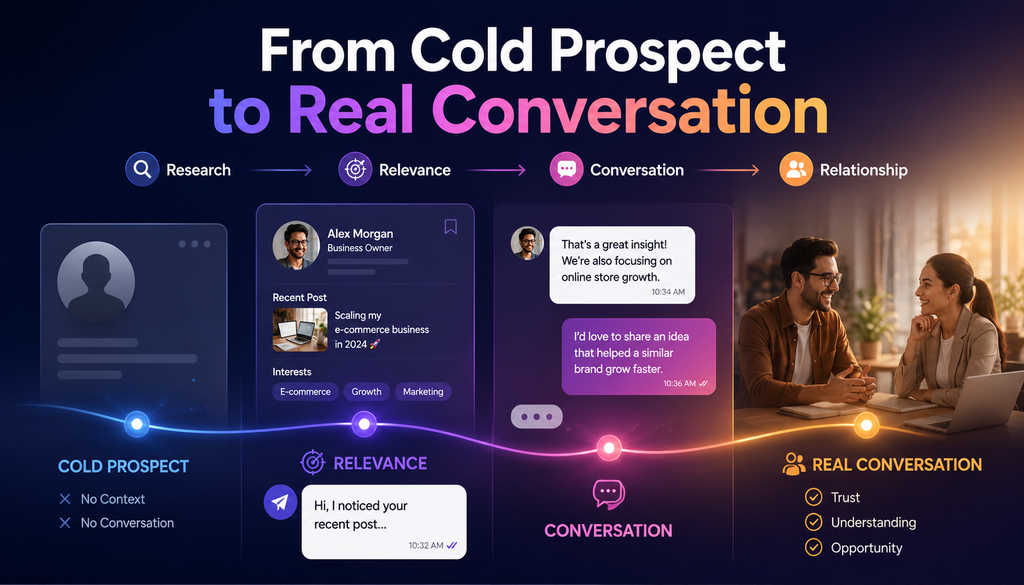
Instagram DM marketing for small businesses is most effective when it is treated as relationship-driven marketing rather than a race to send more messages.
The process starts with identifying the right audience. Then comes prospect research, personalized messaging, genuine conversation, useful follow-up, and careful measurement.
The strongest campaigns do not try to make every person become a customer. Instead, they identify people who have a legitimate reason to talk with the business and create a useful path from initial conversation to potential opportunity.
For businesses that want to keep outreach human and organized, exploring a practical manual approach to Instagram outreach can be a useful next step. The goal is not simply to put more messages into Instagram inboxes. The goal is to create better conversations with people who are genuinely relevant to the business.
When small businesses consistently combine research, personalization, patience, and measurement, Instagram can become much more than a social media channel. It can become a meaningful source of conversations, relationships, qualified leads, and long-term customer opportunities.