In today’s competitive digital landscape, businesses are constantly searching for better ways to connect with prospects, nurture leads, and increase conversions. Direct messaging has become one of the most effective communication channels, especially on platforms like Instagram, where personalized interactions often lead to stronger customer relationships.
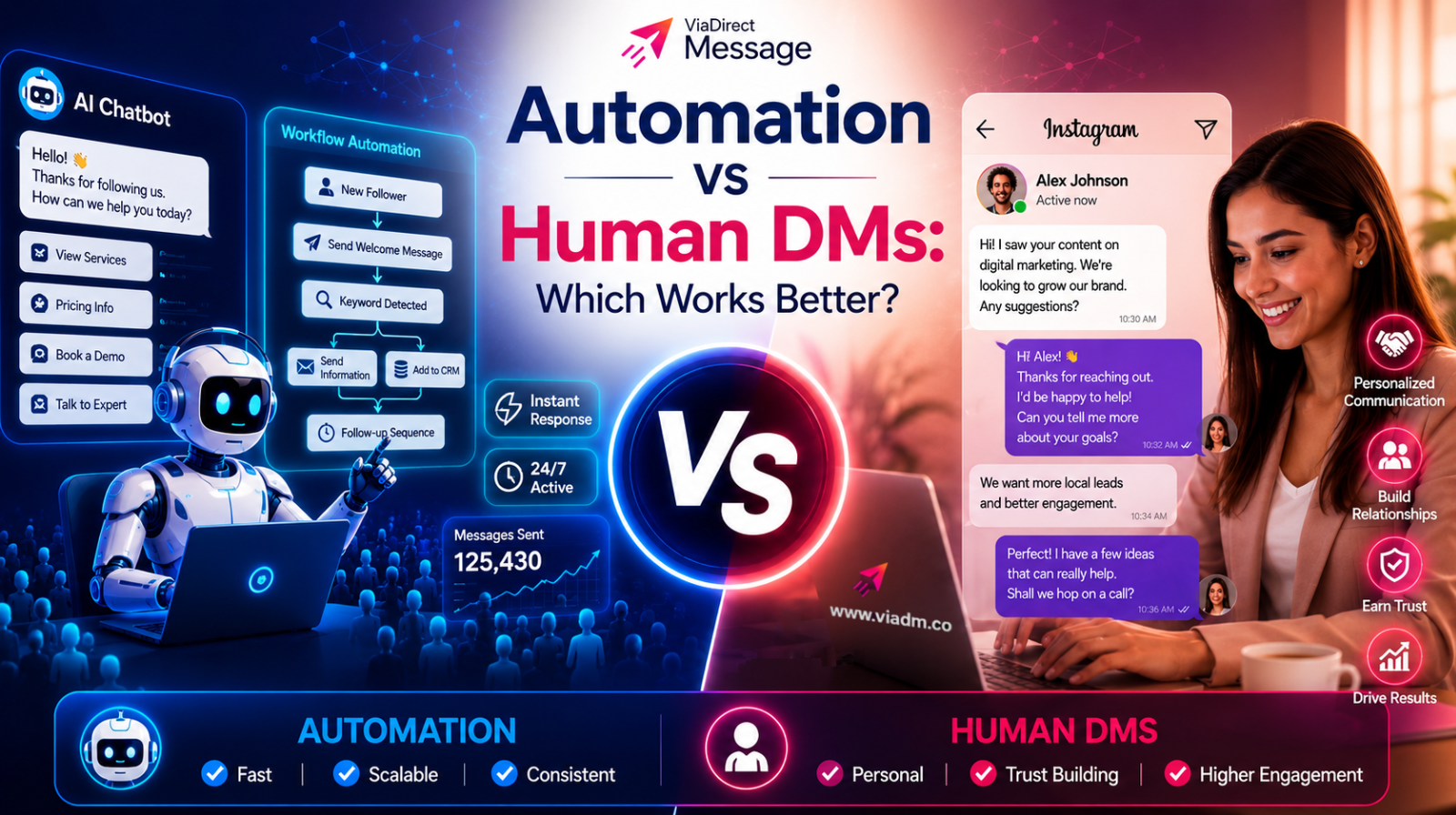
However, as DM marketing continues to grow, a common question arises: Automation vs Human DMs: Which Works Better?
Many businesses are tempted to automate every aspect of their outreach to save time and scale quickly. On the other hand, marketers who prioritize personalization often prefer human-driven conversations that build trust and authenticity.
The truth is that both approaches offer unique advantages and challenges. Understanding when to use automation and when human interaction delivers better results can significantly improve engagement rates and conversion outcomes.
For businesses exploring modern Instagram outreach strategies, solutions such as manual Instagram DM outreach platforms have gained popularity because they help teams manage conversations efficiently while maintaining genuine human interaction.
This article explores the differences between automation and human DMs, their strengths, limitations, real-world applications, and how businesses can determine the best approach for their marketing goals.
Understanding Direct Message Marketing
Direct Message (DM) marketing involves reaching potential customers through private conversations on social media platforms.
Unlike public posts or advertisements, DMs provide a more personal environment where brands can engage directly with users.
Businesses commonly use DMs for:
- Lead generation
- Customer support
- Appointment booking
- Product recommendations
- Event promotions
- Influencer outreach
- Community engagement
According to various social media marketing studies and insights from the Content Marketing Institute, personalized communication often results in higher engagement and stronger customer relationships compared to broad marketing campaigns.
As a result, many organizations are evaluating whether automated messaging systems or human-managed conversations generate better business outcomes.
What Are Automated DMs?
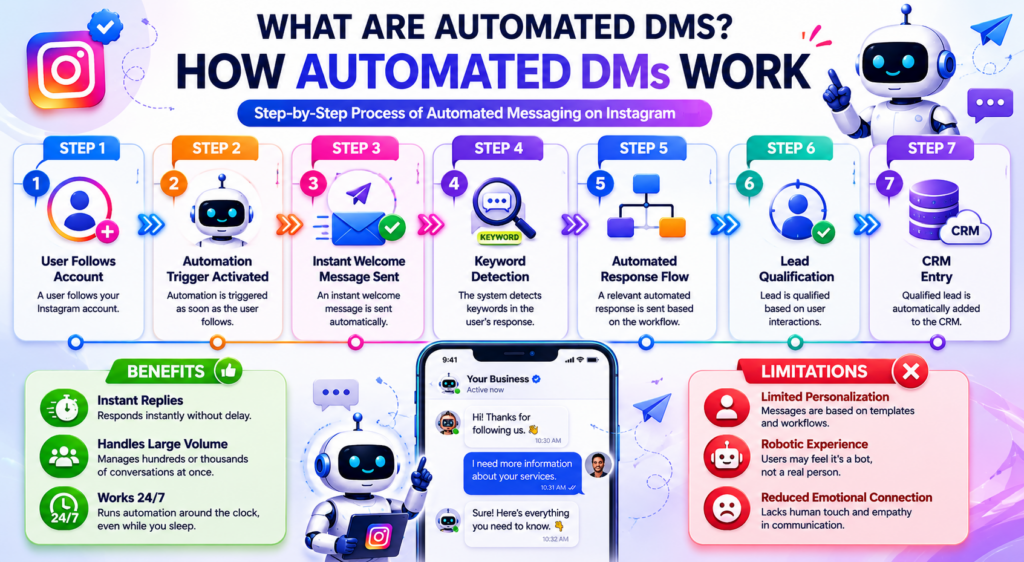
Automated DMs are messages sent through predefined workflows, bots, triggers, or automation software.
These systems automatically respond based on user actions such as:
- Following an account
- Sending a keyword
- Clicking an advertisement
- Filling out a form
- Engaging with content
Automation allows businesses to respond instantly without requiring a team member to be present.
Common Uses of Automated DMs
Businesses frequently use automation for:
- Welcome messages
- FAQ responses
- Lead qualification
- Appointment confirmations
- Event reminders
- Product recommendations
- Customer support routing
Automation is designed primarily to improve efficiency and scalability.
Benefits of Automated DMs
1. Instant Response Time
Modern customers expect immediate replies.
Automated systems can respond within seconds, reducing wait times and improving user experience.
This is especially useful when businesses receive hundreds or thousands of inquiries daily.
2. Scalability
Automation can handle large volumes of conversations simultaneously.
A single workflow can communicate with thousands of users without requiring additional manpower.
For rapidly growing businesses, scalability is often a major advantage.
3. Consistency
Automated systems ensure that every user receives the same information.
This reduces human error and helps maintain consistent messaging across campaigns.
4. Cost Efficiency
Businesses can reduce operational costs by automating repetitive communication tasks.
Routine inquiries that would otherwise consume team resources can be handled automatically.
Limitations of Automated DMs
Despite their advantages, automation has significant limitations.
Lack of Personalization
Most automated messages follow predefined scripts.
As a result, conversations can feel robotic and impersonal.
Users can often identify automated responses immediately.
Reduced Trust
People generally prefer interacting with real humans rather than bots.
When conversations feel automated, engagement rates may decrease.
Difficulty Handling Complex Questions
Automation works best for predictable situations.
However, nuanced questions, objections, or personalized requests often require human judgment.
Platform Restrictions
Many social media platforms continue tightening rules around excessive automation.
Businesses must carefully follow platform guidelines to avoid account limitations.
For example, social media best practices outlined in the Social Media Examiner emphasize maintaining authentic user interactions rather than relying solely on automated engagement.
What Are Human DMs?
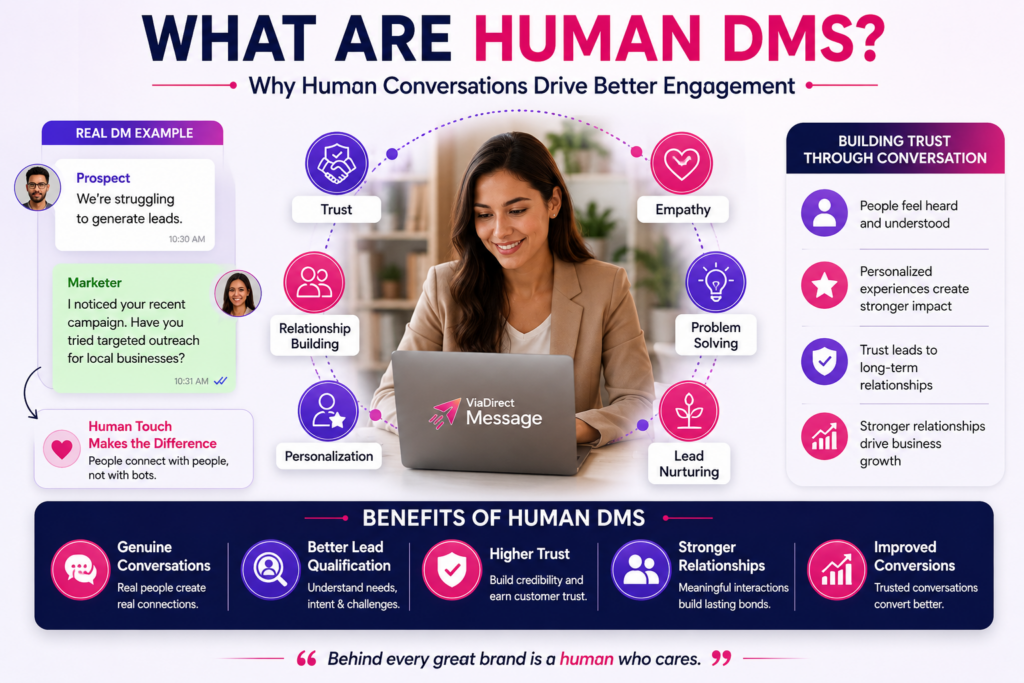
Human DMs involve real people managing and responding to conversations.
Instead of relying on bots or automated sequences, team members engage directly with prospects and customers.
This approach prioritizes authenticity, empathy, and relationship building.
Human-driven outreach remains a preferred strategy for many brands because it creates genuine conversations that lead to stronger customer trust.
Benefits of Human DMs
1. Authentic Conversations
Human interactions feel natural.
People can adapt conversations based on context, personality, and customer needs.
This flexibility often leads to better engagement.
2. Stronger Relationship Building
Trust is one of the most important factors in purchasing decisions.
Human conversations create emotional connections that automated systems struggle to replicate.
3. Better Lead Qualification
Experienced team members can identify buying intent, objections, and opportunities more effectively than automated workflows.
This improves lead quality and sales outcomes.
4. Higher Conversion Potential
Personalized conversations often result in higher conversion rates because they address specific customer concerns in real time.
5. Adaptability
Humans can respond to unexpected questions, objections, and situations without requiring predefined workflows.
This adaptability is critical in complex sales environments.
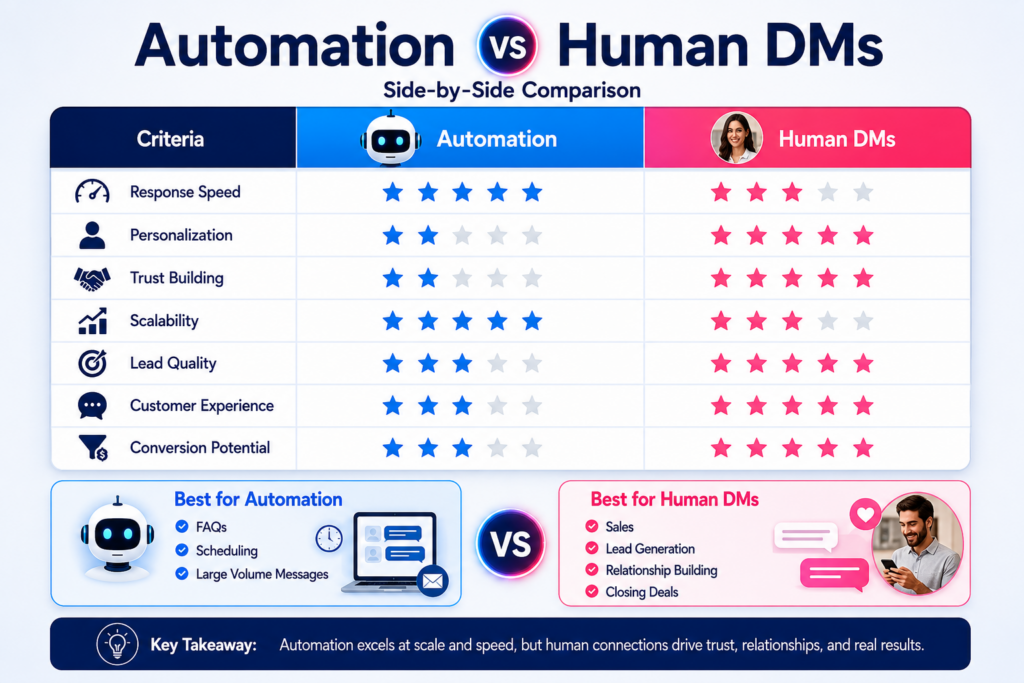
Automation vs Human DMs: A Detailed Comparison
Response Speed
Automation
Automation wins in terms of speed.
Users receive immediate responses regardless of time zone or business hours.
Human DMs
Response times depend on team availability.
However, thoughtful responses may create a better user experience despite longer wait times.
Winner: Automation
Personalization
Automation
Limited to predefined variables and workflows.
Human DMs
Capable of understanding context, tone, preferences, and unique situations.
Winner: Human DMs
Relationship Building
Automation
Suitable for basic interactions.
Human DMs
Excellent for creating trust and long-term customer relationships.
Winner: Human DMs
Scalability
Automation
Can manage thousands of conversations simultaneously.
Human DMs
Scaling requires additional staff and resources.
Winner: Automation
Conversion Quality
Automation
Can qualify leads effectively but may struggle with complex buying decisions.
Human DMs
Better suited for handling objections and nurturing prospects.
Winner: Human DMs
Customer Experience
Automation
Efficient but sometimes impersonal.
Human DMs
More engaging and authentic.
Winner: Human DMs
Why Human DMs Often Generate Better Results
While automation offers efficiency, many businesses discover that human interactions produce stronger outcomes over time.
Several factors contribute to this advantage.
People Buy From People
Consumers naturally trust human interactions more than automated messages.
When a real person listens and responds thoughtfully, prospects feel valued.
This increases the likelihood of meaningful engagement.
Personalized Responses Create Better Engagement
A personalized DM can reference:
- User interests
- Previous interactions
- Industry challenges
- Specific goals
These details make conversations more relevant and effective.
Human Conversations Handle Objections Better
Prospects rarely follow predictable buying paths.
Questions, concerns, and objections often emerge unexpectedly.
Humans can adapt instantly and provide tailored responses that move conversations forward.
The Growing Demand for Manual DM Outreach
As audiences become more aware of automation, many brands are returning to manual outreach strategies.
Businesses increasingly recognize that authentic conversations create stronger customer experiences.
This trend has contributed to the popularity of platforms that support manual DM management rather than automated messaging.
For example, businesses looking to improve personalized outreach often explore resources such as Instagram DM marketing strategies and outreach insights to better understand how genuine conversations impact customer engagement.
The goal is not simply to send more messages but to create meaningful interactions that drive real business results.
Real-World Example: Automation vs Human Outreach
Consider two consulting firms targeting small business owners.
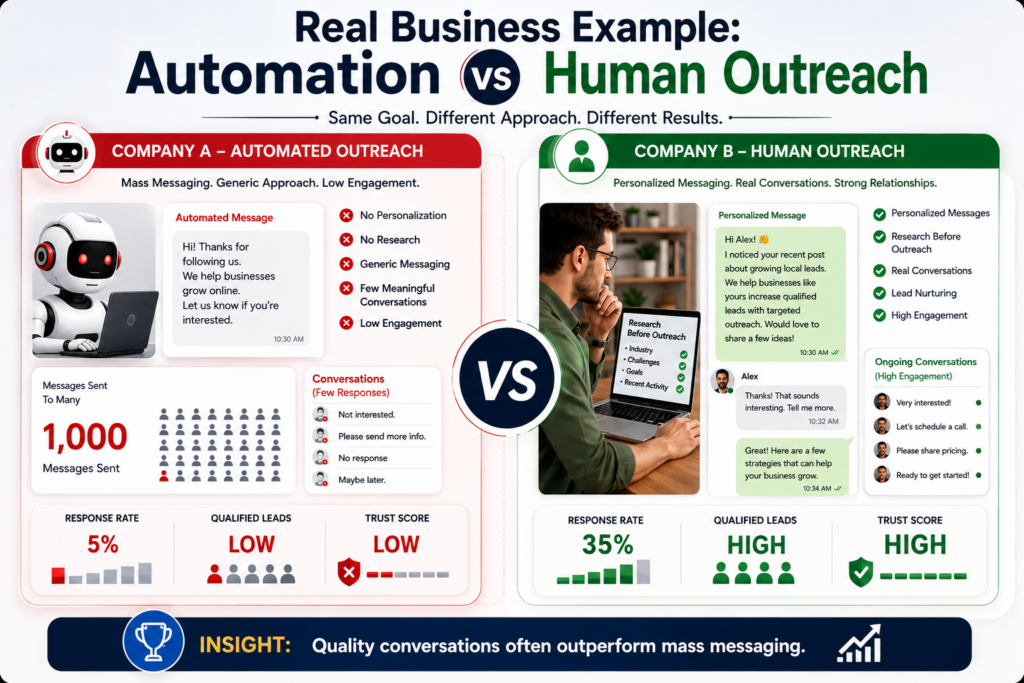
Company A Uses Automated DMs
The company sends automated welcome messages to every new follower.
The message includes a generic introduction and booking link.
Results:
- High message volume
- Low engagement rate
- Few meaningful conversations
Company B Uses Human DMs
The company researches prospects before reaching out.
Team members send personalized messages referencing specific business challenges.
Results:
- Lower message volume
- Higher response rates
- Stronger relationships
- More qualified leads
Although Company B spends more time per conversation, the quality of interactions generates better conversion opportunities.
When Automation Makes Sense
Automation still plays an important role in marketing.
Businesses may benefit from automation when:
Managing High Inquiry Volumes
Customer support teams often use automation to answer frequently asked questions.
Appointment Confirmations
Automated reminders reduce missed appointments.
Event Registrations
Automation helps manage registrations efficiently.
Lead Routing
Automated systems can direct inquiries to the appropriate department.
In these situations, automation improves operational efficiency without significantly impacting customer experience.
When Human DMs Are the Better Choice
Human-driven messaging is generally preferable when:
Building Relationships
Trust-building requires genuine interaction.
High-Value Sales
Complex purchasing decisions often involve personalized communication.
Influencer Outreach
Authenticity matters significantly in partnership discussions.
Community Building
Engaged communities grow through meaningful conversations.
Customer Retention
Existing customers appreciate personalized support and follow-up.
Finding the Right Balance
The debate around Automation vs Human DMs is not necessarily about choosing one approach exclusively.
The most successful businesses often combine both strategically.
A balanced approach may involve:
- Automation for routine tasks
- Humans for relationship-building conversations
- Automated scheduling
- Personalized sales discussions
- Automated lead collection
- Human follow-up
This hybrid model allows businesses to maintain efficiency while preserving authenticity.
Why Manual DM Platforms Are Becoming More Popular
Many businesses want the efficiency of organized outreach without sacrificing genuine conversations.
This demand has created interest in manual DM management solutions that help teams handle outreach systematically while keeping interactions human.
Unlike traditional automation tools, manual outreach platforms focus on assisting users in managing conversations rather than replacing human communication.
Businesses seeking to improve outreach quality often prefer solutions that support authentic engagement while maintaining workflow efficiency.
For organizations interested in building stronger customer relationships through personalized messaging, manual DM outreach solutions designed for genuine engagement can provide a practical alternative to fully automated approaches.
Future Trends in DM Marketing
Several emerging trends are shaping the future of direct messaging.
AI-Assisted Personalization
Artificial intelligence may help teams prepare insights while humans manage conversations.
Privacy-Focused Communication
Customers increasingly value secure and transparent communication practices.
Relationship-Based Marketing
Brands are shifting from mass outreach toward relationship-driven engagement.
Quality Over Quantity
Businesses are prioritizing meaningful conversations rather than simply increasing message volume.
These trends suggest that human interaction will remain a critical component of successful DM marketing strategies.
Conclusion
When evaluating Automation vs Human DMs, the answer ultimately depends on business objectives.
Automation excels in speed, scalability, and efficiency. It is highly effective for handling repetitive tasks, managing large inquiry volumes, and streamlining workflows.
However, human DMs consistently outperform automation when it comes to trust, relationship building, personalization, and conversion quality.
Customers want authentic interactions. They want to feel understood rather than processed through a workflow.
As a result, businesses that prioritize genuine conversations often experience stronger engagement, higher-quality leads, and better long-term customer relationships.
The most effective strategy is often a balanced one—using automation where efficiency matters and relying on human conversations where relationships drive results.
For organizations focused on sustainable growth, the future of DM marketing will likely belong to those who combine operational efficiency with authentic human engagement.